Program: #26-03🏆 Air Date: Jan 12, 2026
Inspired by the recent recordings by the ensemble named for him, we come to some recordings dedicated to the son of an Austrian Colonel who comes to Italy.
I. Alla Luce: Music of Giovanni Girolamo Kapsberger (Chatham Baroque CB-01)
Since its founding in 1990, Chatham Baroque has become “One of the country’s most distinguished period ensembles” (Palisadian Post), and “One of Pittsburgh’s greatest treasures” (Pittsburgh Post-Gazette).
The ensemble has toured across the United States as well as in South America and Mexico, the Virgin Islands, and Canada. The New York Times praises their “colorful virtuosity”; the Washington Post calls them “musically impeccable”; the Chicago Tribune, “a splendid period-instruments ensemble”; and the Pittsburgh Post-Gazetteproclaims, “Pound for pound, you aren’t going to find a better ensemble … than Chatham Baroque,” and “in terms of quality of artistry, Chatham Baroque is comfortably on par with the Pittsburgh Symphony Orchestra and Pittsburgh Opera.” Chatham Baroque’s productions have been repeatedly listed among Pittsburgh Post-Gazette’s “Ten Best Classical Concerts” and the ensemble was called one of the “Top 50 Cultural Forces in Pittsburgh,” serving as ambassadors for early music in Pittsburgh both nationally and abroad.
Chatham Baroque prides itself on its commitment to the Pittsburgh region. It is Ensemble-in-Residence at WQED-FM and Calvary Episcopal Church, and its scope of work has been substantially broadened in recent years by exciting collaborations with Quantum Theatre, Pittsburgh Symphony, Pittsburgh Opera, Renaissance & Baroque, Pittsburgh Festival Opera, and Attack Theatre. Chatham Baroque also gives free family concerts at public libraries, presents its children’s series Peanut Butter & Jam Sessions, and participates in other various community and early childhood events.
The ensemble continues to thrive with a full calendar of concerts, tours, and musical collaborations, and has recorded ten critically acclaimed CDs, the latest of which is No Holds Barred: Stylus Fantasticus Sonatas and Suites of Biber, Schmelzer, Bertali & Schein (2017).
| 1 | Gagliarda Prima | 1:23 |
| 2 | Corrente Sesta | 1:18 |
| 3 | All’ombra Alla Fonte | 2:55 |
| 4 | Ballo Secondo | 2:18 |
| 5 | Correte Pescatori | 3:24 |
| 6 | Sinfonia Decimaquinta à Quattro | 2:18 |
| 7 | Lascivette Pastorelle | 2:27 |
| 8 | Toccata VII | 4:33 |
| 9 | Sinfonia Duodecima A Due Canti | 2:43 |
| 10 | Gagliarda Quinta | 1:12 |
| 11 | Corrente Quinta | 2:02 |
| 12 | Torna di Novo | 2:40 |
| 13 | Sinfonia Decimasettima A Quattro | 2:20 |
| 14 | Alla Luce | 2:38 |
| 15 | Colascione | 2:14 |
| 16 | Piva | 2:53 |
| 17 | Canario | 2:40 |
| 18 | S'io Sospiro | 2:24 |
| 19 | Sinfonia Decimaterza A Un Canto | 1:36 |
| 20 | Belle Ninfe | 2:05 |
| 21 | Alla Caccia | 2:20 |
| 22 | Sarabanda | 1:52 |
| 23 | Gagliarda sesta | 1:45 |
| 24 | Corrente Seconda | 1:09 |
| 25 | Occhi Ridenti | 3:22 |
II. Splendore di Roma (Johannette Zomer, s./Fred Jacobs, theorbo). Channel Classisc CCS 19998.
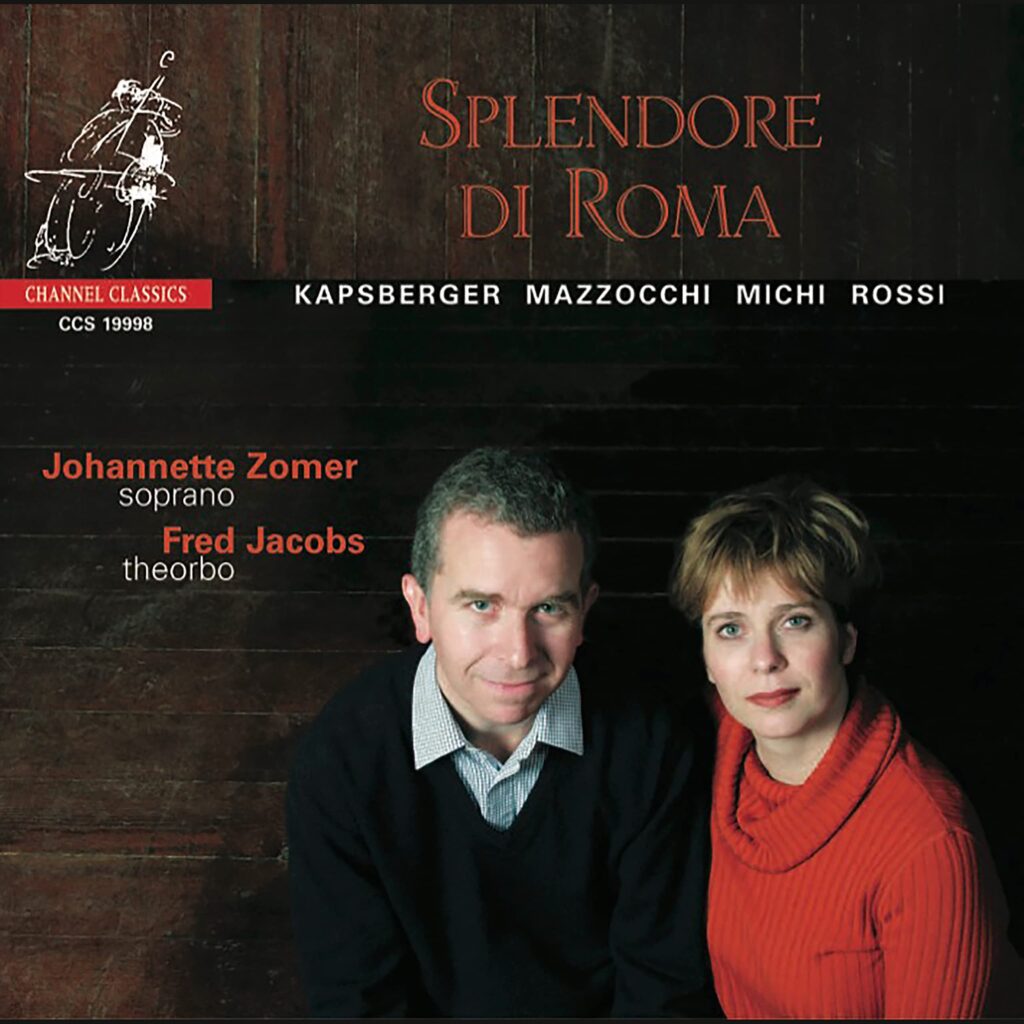
During the pontificate of Urban VIII (1623-1644), the arts in Rome enjoyed a period of unprecedented splendor. In the context of the Counterreformation, they were part of the propaganda arsenal of papal might. The architecture of Bernini and Borromini, as well as the musiche of Mazzocchi and Rossi, echoing in the private apartments of the cardinals and the accademie, where the elite of Rome congregated to enjoy music and poetry, bear witness to this trend.
The texts set in this music were often deliberately vague as to whether their content was secular or religious. The primary intent was to express of the power of the words and their affect, by using the richest possible harmonic support. Composers like Landi and Michi both sang and accompanied themselves; the instruments which were considered most suitable for this purpose were the theorbo and the harp, which could accommodate to the voice at nearly every dynamic level. Mazzocchi, in his compositions, even provides indications of changes to tempo and dynamics. He sometimes gives the accompaniment an independent part in order to emphasize the text.
For example, in ‘Spoglie’, the theorbo follows the text “passerà l’ombra mia la ripa avara” in a literally shadow-like way. The most important virtuoso theorbo player of 17th century Rome was Johann Hieronymus Kapsberger, Il Tedesco della Tiorba (the German Theorbist). In addition to solo compositions for theorbo and lute, his publications include collections of motets, villanelle, and ‘arie’, some of which have a fully written-out accompaniment in tablature, such as ‘Già risi’, recorded on this cd.
- Dove mi lasci
- Gia risi del mio mal
- Cinta di rose
- Pargoletto son io
- Toccata for lute No. 3 (from D'intavolatura di Lauto, 1611)
- Su l'oriente, for voice & theorbo
- Empo cor, core ingrato, for voice & theorbo
- Work(s)~[Unspecified] Gagliarda
- Fin dal monte Sion, for voice & theorbo
- Spoglie che fosti, for voice & theorbo
- Voi, voi rubaste il core, for voice & theorbo
- Canzona for lute No 1
- Leggiadra rosa
- Non si scherzi con amore
- Toccata for lute No. 2 (from D'intavolatura di Lauto, 1611)
- Or che la notte del silenzio amica, for voice & continuo
- Passacaglia
- Disperati, che aspetti pia, cantata for voice & continuo
- Addio, perfida, addio, for voice & continuo
III. Il Tedesco: Kapsberger in Rome 1610 (Escadron Volant de la Reine). Harmonia Mundi HMM 902645.
From Gramophone: Johann Hieronymus (or Giovanni Girolamo) Kapsberger is best known, together with Alessandro Piccinini, for providing grateful modern performers and programme planners with almost all the usable repertoire of early 17th-century Italian theorbo solos. His secular vocal music, though reasonably plentiful, has rarely been considered, and when it has, has tended to draw down disdain. A frisky disc of villanelle last year from Les Kapsber’girls (Muso) helped address that, and now the opulently named L’Escadron Volant de la Reine give him another chance, proving him well worth an album’s worth of exposure.
Born in Venice to a German father around 1580, Kapsberger moved in his twenties to Rome, where he made a reputation for himself as a theorbo player and got in with the wealthy Barberini family, for whose scion Pope Urban VIII he worked from 1624. The vocal works we get here come from publications issued between 1609 and 1627, and take in five-part madrigals, stagey little villanelle for one to three solo voices, and more declamatory (though at the same time floridly ornamented) arie passeggiate for single voice – all with continuo accompaniment.
Though nothing here has the emotional range and musical breadth of a Monteverdi – many of the pieces are less than two minutes long – they generally respond to text quickly and with a shot of expressive or pictorial imagination direct enough to make them effective as vignettes. Kapsberger really grabs at the emotional contracts in La mia leggiadra Filli, and sets laughing and weeping tumbling over each other in Io rido amanti. Fabricator d’inganni amusingly sets an ‘old adage’ refrain as a chanted proclamation, the lament Tu, che pallido essangue sustains its grief well as it rises to the defiant declaration ‘Un amante son io’ (‘A lover am I!’), and Figlio dormi is a genuinely touching lullaby. In short, there’s usually something to listen for.
The performances are lively and sympathetic. The singers of this young group show good style and sensitive expression; a continuo section of gamba, theorbo, harp, harpsichord and organ allows plenty of variation of colour and weight; a violin makes occasional telling contributions; and Thibaut Roussel, as Kapsberger on theorbo, does not muff his moment in a tender and graceful Passacaglia. Not a must-buy, perhaps, but Baroque fans should find it of interest.
- Kapsberger: Lunge da voi ben mio 01:25
- Kapsberger: Ballo 01:39
- Kapsberger: La mia leggiadra Filli 01:40
- Kapsberger: Nelle guancie di rose 01:31
- Kapsberger: Sinfonia No. 13 01:49
- Kapsberger: Chi vi mira ben mio 01:51
- Kapsberger: Uscita 01:14
- Kapsberger: Ultimi miei sospiri 02:23
- Kapsberger: Su l'erbe affissomi 03:27
- Kapsberger: Sconsolato mio core 01:21
- Kapsberger: Fabricator d'inganni 02:59
- Kapsberger: Sinfonia No. 9 06:18
- Kapsberger: Care lagrime mie 02:21
- Kapsberger: Occhi soli d'Amore 04:33
- Kapsberger: Se la doglia 02:15
- Kapsberger: Passacaglia No. 10 05:44
- Kapsberger: Io rido amanti 01:18
- Kapsberger: Amor la Donna mia 01:40
- Kapsberger: Tu, che pallido essangue 03:35
- Kapsberger: Anima mea 03:19
- Kapsberger: Figlio dormi 05:22
- Kapsberger: Colascione 01:46
- Kapsberger: Ah, Clori anima mia 01:26
- Kapsberger: Corrente quinta 01:13
- Kapsberger: Se turbando Austro le stelle 02:26