Program: #25-34🏆 Air Date: Aug 18, 2025
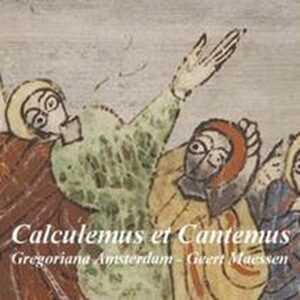
For the 2015 Gregoriana Amsterdam festival, Geert Maessen organized an extraordinary event reconstructing original Mozarabic Chant for early medieval Spain.
NOTE: All of the music on this program comes from the Gregoriana Amsterdam directed by Geert Maessen. It is on the Gregoriana Amsterdam label and is 9789081996914. For complete information:
Calculemus et Cantemus: Towards a Reconstruction of Mozarabic Chant (PDF)
The melodies of the vast majority of over 5000 chants of the mozarabic rite preserved in unheightened neumatic notation of about 40 Iberian manuscripts and fragments from the ninth till thirteenth century are unknown and were probably never pitch-readable notated. Many scholars believe these melodies are irretrievably lost. Last year I published the book Calculemus et Cantemus, Towards a Reconstruction of Mozarabic Chant. In this book I have published 50 computational reconstructions for these lost melodies agreeing in all detail with our knowledge of the early notation. I do not claim I restored the lost melodies, but I do claim the melodies were produced in a (semi-)automatic way and are the best possible melodies given some simple conditions I described in the book.
For Cantus Planus in Dublin I have argued that it is possible to make a meaningful system for the objective evaluation of the authenticity of computationally restored mozarabic chants, independent of any knowledge of the lost melodies and only based on our knowledge of the mozarabic notation and the method used for the reconstruction. In my book I used and explained such a method. —Geert Maessen
Prior to the establishment of the Roman rite with its Gregorian chant, in the Iberian Peninsula and Southern France the Mozarabic rite, with its own tradition of chant, was dominant from the sixth until the eleventh century. Few of these chants are preserved in pitch readable notation and thousands exist only in manuscripts using adiastematic neumes which specify only melodic contour relations and not exact intervals. Though their precise melodies appear to be forever lost it is possible to use computational machine learning and statistical sequence generation methods to produce plausible realizations. Pieces from the León antiphoner, dating from the early tenth century, were encoded into templates then instantiated by sampling from a statistical model trained on pitch-readable Gregorian chants. A concert of ten Mozarabic chant realizations was performed at a music festival in the Netherlands. This study shows that it is possible to construct realizations for incomplete ancient cultural remnants using only partial information compiled into templates, combined with statistical models learned from extant pieces to fill the templates.
Gregoriana Amsterdam is a (small) vocal ensemble specialized in the performance of the so-called Gregorian chant, one the oldest known musical repertoires of some substance of Western Europe. The base for Gregoriana’s performance practice is formed by the oldest known manuscripts in which the repertory has been preserved with musical notation, and besides among other things by medieval treatises about music. As much as possible, the ensemble uses self-made reconstructions and transcriptions of the repertory. Since March 2014, especially from the tenth-century Mozarabic León antiphoner.
|
1 |
OV |
Domine labia mea aperies |
1:34 |
|
2 |
HYMN |
O triplex honor |
2:02 |
|
3 |
ALL |
Columna ignis ducem habuerunt |
1:13 |
|
4 |
PSLD |
Alleluia ubicumque fuerint |
1:39 |
|
5 |
ALL |
Tres pueri iussu regis in fornace |
1:37 |
|
6 |
RS |
Haec dicit Dominus visitabo |
2:49 |
|
7 |
HYMN |
Alleluia piis edite |
2:51 |
|
8 |
ANT |
Alleluia tu Domine susceptor + Ps 3 |
2:07 |
|
9 |
ANT |
Alleluia cantemus Domino + Ex 15 |
2:06 |
|
10 |
ANT |
Clama ne cesses + Is 58 |
2:04 |
|
11 |
RS |
Ecce nunc tempus acceptabile |
3:26 |
|
12 |
LC |
Sermo Sancti Augustini Episcopi |
3:20 |
|
13 |
TRN |
Nunc ecce derident me |
6:33 |
|
14 |
HYMN |
O Nazarene |
3:49 |
|
15 |
ANT |
Bone magister + Ps 118: A |
1:54 |
|
16 |
ANT |
Si ego Dominus + Ps 118: B |
1:57 |
|
17 |
ANT |
Si haec scitis + Ps 118: C |
1:57 |
|
18 |
RS |
Conclusit vias meas inimicus |
5:16 |
|
19 |
LC |
Seq. Sermo S. Augustini Episcopi |
1:45 |
|
20 |
PSLM |
Deus Deus meus respice in me |
6:55 |
|
21 |
LC |
Seq. Sermo S. Augustini Episcopi |
2:35 |
|
22 |
CNT |
Cantemus Domino gloriose enim |
3:43 |
|
23 |
LC |
Daniel prophetae |
1:28 |
|
24 |
BNS |
Benedictus Domine Deus patrum |
9:25 |
|
25 |
CP |
Kyrie, Pater noster, oratio, Benedicamus |
3:45 |
|
77:52 |