Program: #26-31🏆 Air Date: Jul 27, 2026
Yet again we are finding works discovered by Manfred Cordes, including this Nuremberg-based composer who set these texts “for consolation in Christian gatherings to be performed musically, all in German."
This program is part of a special series.
Continues in: ⮞ #26-33 🔒🏆Manfred Cordes, continued
NOTE: All of the music on this program is from the recording Melchior Franck: Bußpsalmen Nürnberg 1615 (Weser-Renaissance/Manfred Cordes). CPO 777 181-2.
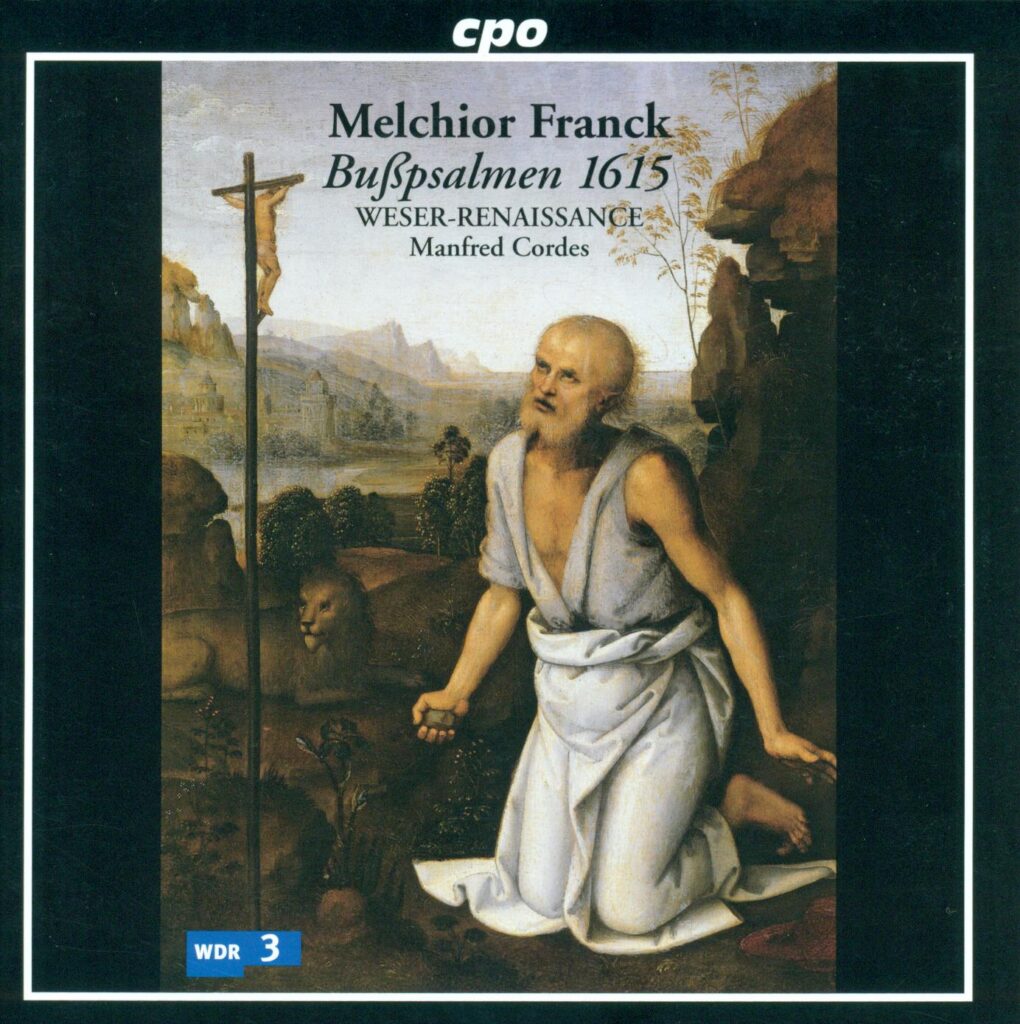
Since the early Middle Ages, the seven penitential psalms have been an integral part of the penitent's confession; particularly during the High Renaissance, they inspired numerous polyphonic settings—mostly in Latin—by composers such as Andrea Gabrieli,
Orlando di Lasso, and Leonhard Lechner. Melchior Franck’s German-language *Penitential Psalms of the Royal Prophet David*, published in 1615, remained undiscovered until modern times—that is, until Manfred Cordes, director of the ensemble Weser-Renaissance, rediscovered this treasure of sacred music.
Melchior Franck’s penitential psalms offer a fascinating wealth of material, ranging from dramatic to contemplative moments, and this performance fully exploits that musical diversity. As always with this ensemble’s recordings, the exemplary articulation of the text, the careful balance between vocal and instrumental parts, and the transparency of the voice leading are impressive; yet on this occasion, Weser-Renaissance also delivers a captivating expressive range—rich in nuanced emotional moods—that makes these compositions truly resonate as deeply personal, internalized expressions of a repentant, despairing soul.
From MusicWeb International: Melchior Franck was one of many German composers whose life and career were severely affected by the Thirty Years War (1618-1648). He was born in Zittau as son of a painter, where he may have studied under Christoph Demantius. Little is known for sure about the early stages of his career, but around 1600 he was a member of the choir of St Anna Church in Augsburg. Here he may have been a pupil of Adam Gumpelzhaimer, Christian Erbach and Hans-Leo Hassler. The connection with Hassler seems without much doubt: both went to Nuremberg in 1601, and Franck's oeuvre shows the influence of Hassler. On the one hand there is the style of the Franco-Flemish school which Hassler had inherited from his teacher Leonhard Lechner; on the other hand Franck made use of the antiphonal style of the Gabrielis which Hassler had studied in Venice.
In 1602 or 1603 Franck became Kapellmeister of Duke Johann Casimir of Saxe-Coburg who was a great music-lover. It was here that the Thirty Years War impinged on Franck's life. In the 1630s the city and its surroundings were destroyed and the economy ruined. Moreover the Duke died in 1633 and Franck himself lost his wife and two children. The new Duke, Johann Ernst, was less passionate about music and was also forced to take drastic measures to restore the economy. The court chapel was much reduced, and so was Franck's salary. He died poverty-stricken in 1639.
Franck was a very productive composer. Between 1601 and 1636 forty collections of motets were printed. His oeuvre also shows a wide variety of genres: sacred music on Latin and German texts, occasional compositions, secular vocal music and instrumental music. In his vocal music Franck pays much attention to the text, and in this respect he points in the direction of Heinrich Schütz. But Franck's works are mostly rooted in the 'prima prattica': only in the latest stage of his career did he write music with a basso continuo part.
In 1615 Franck published his 'Threnodiae Davidicae', or "Penitential Psalms of the Royal Prophet David". It consists of the seven Penitential Psalms (6, 32, 38, 51, 102, 130, 143) for six voices. Every setting is divided into a number of motets: two in Psalms 6, 130 and 143, three in Psalms 32, 38 and 51, and five in Psalm 102. Many composers of the renaissance composed a complete cycle of Penitential Psalms, the best-known of them being Orlandus Lassus.
The Penitential Psalms - and penitence in general - were an important part of the theological thinking of Martin Luther. His German translation of the Penitential Psalms was his first independently published work and dates from 1517. Probably to underline this importance Franck makes use of this text for his settings of the Penitential Psalms, making sure everyone would be able to understand their meaning. It could well be that the consistent use of the full six voices - only twice Franck reduces the number of voices, which was quite common at the time - is also a way to emphasize the importance of these Psalms.
As the playing time of every single Psalm shows, these settings are rather concise. This is achieved by using a homo-rhythmic and declamatory style, whereas in the shorter Psalms Franck makes use of longer melismatic phrases. There are several examples of fine text illustration. In Psalm 38 the tempo is speeded up on "denn deine Pfeile stecken in mir" (for your arrows pierc me) whereas long-held notes are used for "schwere Last" (heavy burden). "Ich gehe krumm und sehr gebückt" (I walk crooked and bowed down low) is set to a descending figure. A shift in metre is used for "daß die Gebeine fröhlich werden" (that the bones ... may be glad).
The performance pays tribute to what was common practice at the time as both voices and instruments are used. The instruments either play 'colla parte' or replace the voices. The instruments used here are cornetto muto, four viole da gamba, dulcian and harp. The singers are well suited to their task: they sing with great clarity and the delivery of the text is readily understandable. The lines are beautifully shaped and there is a fine dynamic shading which is fully appropriate to the music of this time. The voices blend well and the balance with the instruments is also satisfying.
I found the beginning of Psalm 102 somewhat hesitant; but perhaps that was deliberate, considering the text: "Lord, hear my prayer". Marnix De Cat has a very fine voice, but here he seems at times to feel a bit uncomfortable, probably because his part in the score is a little lower than what suits him best. One could also argue Jan Van Elsacker's voice is sometimes a little too edgy. These are however very minor details in what is a splendid recording of a collection of pieces which has never before been recorded. The quality of these Psalms is first-rate and they suggest Melchior Franck's music is unjustly neglected. More recordings of his oeuvre in performances like this would definitely be welcome.
The booklet contains concise programme notes by Manfred Cordes, the English translation of which is sometimes less than precise. In the translation also some lines from the German text have been omitted. The lyrics are printed with an English translation.
Johan van Veen
Penetential Psalms 'Threnodiae Davidicae’
| Bußpsalm Nr. 1 (Psalm 6) | 00:06:48 |
| Bußpsalm Nr. 2 (Psalm 32) | 00:07:48 |
| Bußpsalm Nr. 3 (Psalm 38) | 00:09:19 |
| Bußpsalm Nr. 4 (Psalm 51) | 00:07:39 |
| Bußpsalm Nr. 5 (Psalm 102) | 00:14:12 |
| Bußpsalm Nr. 6 (Psalm 130) | 00:05:10 |
| Bußpsalm Nr. 7 (Psalm 143) | 00:07:02 |
This program is part of a special series.
Continues in: ⮞ #26-33 🔒🏆Manfred Cordes, continued