Program: #26-18🏆 Air Date: Apr 27, 2026
Tenor Kieran White and lutenist Cédric Meyer present a program of songs by John Dowland and his less-recorded contemporary, John Danyel.
NOTE: All of the music on this program comes from tenor Kieran White and lutenist Cédric Meyer. It is on SOMM Recordings label and is SOMMCD 0718.
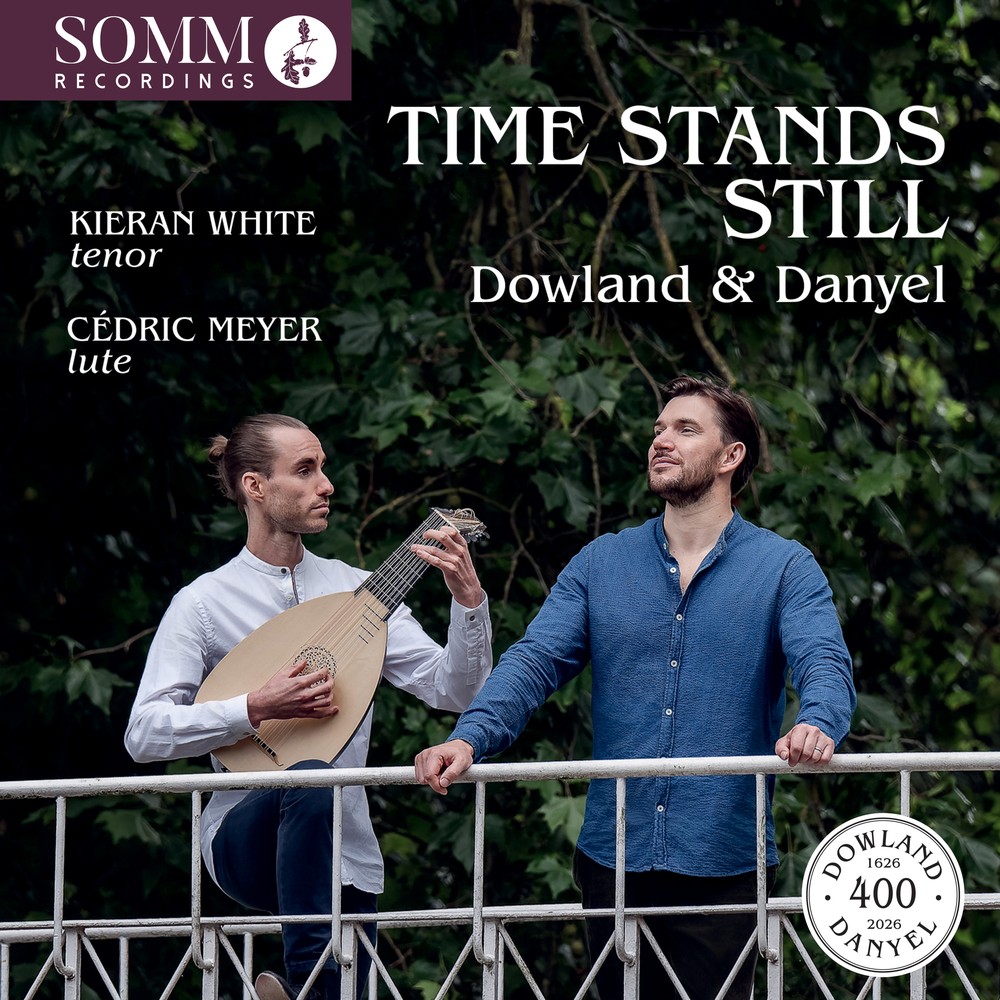
SOMM Recordings celebrates the 400th anniversary of two Renaissance masters of the First Golden Age of English Song: John Dowland (1563–1626) and John Danyel (1564–1626). This recital for tenor and lute takes its name from Dowland’s song, Time Stands Still.
The recording features British tenor Kieran White, who was a chorister at Wells Cathedral and held a Kohn Foundation Scholarship at the Royal Academy of Music. The Guardian has praised White’s ‘pure, luminous tenor’ and Opera Magazine his ‘extraordinary emotional clarity.’ He performs with long-time collaborator and friend, the Swiss-French lutenist Cédric Meyer, who holds two Masters of Arts and a postgraduate certificate with a specialisation in Early Music. Meyer plays here on his personally handcrafted eight-course Renaissance lute, based on an extant Italian lute from 1592, designed and hand-built to suit the timbre of Kieran White’s voice.
From Planet Hugill: A new disc from tenor Kieran White and lutenist Cédric Meyer on SOMM records, Time Stands Still, pairs the songs of John Dowland (1563 - 1626) with those of his almost exact contemporary, John Danyel with selections from Dowlands three books of airs, and A Musicall Banquet, alongside songs from Danyel's Songs for the Lute, Viol and Voice and Mrs M.E. her funeral tears for the death of her husband.When it comes to the songs for voice and lute by Dowland and others, our contemporary performance style is very informed by the rediscovery of this music in the 20th century. Countertenor Alfred Deller's performances of Dowland were seen to distil the very essence of the melancholy of the 17th century English song. Performances like Deller's became the epitome of how these songs sounded. The reality is of course that we have no real idea what Dowland's songs sounded like to the composer himself and each modern performer has, to a certain extent, to find their own way.
In A history of singing by John Potter and Neil Sorrell, they go as far as to suggest that if Dowland was performing his songs to his own accompaniment he would probably have sounded far more like Sting than a contemporary classical singer, thanks to the changes in vocal production. A sobering thought!
Kieran White is a British tenor whose voice leads him into the French haut-contre repertoire, and he has performed leading roles in a number of Rameau's operas including Castor in Castor et Pollux, Hippolyte in Hippolyte et Aricie, Valère and Tacmas in Les Indes Galantes. We caught him in Hippolyte et Aricie at Grimeborn back in 2019 [see my review] and more recently he was singing Céphale in Élisabeth Jacquet de La Guerre's Céphale et Procris also at Grimeborn [see our review]. Of course his repertoire is wider than this. Last year he recorded a disc of 17th century Italian music, Cupid's Ground Bass with soprano Lucine Musaelian and the Bellot Ensemble [see my review].
For this disc of Dowland and Danyel, White and Meyer have chosen to take a distinctive approach to the music. They perform the music a whole tone higher than the original keys, suiting White's specific voice type. Meyer's lute is therefore tuned up from standard pitch so that it transposes from the original tablatures. The instrument is based on an extant Italian lute from 1592. The vibrating string length is slightly shortened in order to function at the new pitch, and the woods were chosen to match White’s voice quality. The intention was to lend a new, personal touch to the sonic relationship between voice and lute.
Much of Dowland's popularity stems from his international career and business sense, including an enthusiasm to preserve his music authentically by publishing it himself in an effort to prevent unscrupulous printers from disseminating his work in pirated editions without his knowledge or permission. In Dowland’s day widespread availability of his publications from the last years of the 16th century brought his music to the masses in a way that is far removed from the rather esoteric reputation his music receives today. This would have been music played by genuine musical amateurs, real chamber music in that the performances would have taken place in more intimate personal spaces.
The songs and lute solos on the recording are drawn from the First Booke of Songes or Ayres, published in 1597, the Second Booke, published in 1600, the Third and Last Booke, published in 1603 and A Musicall Banquet from 1610.
White's voice here has a lovely clarity to it. Beautifully even tone and line are combined with a sense of the words and fine diction. This is most definitely a tenor voice and there is a clear brightness to the sound along with an ease in the tessitura. Perhaps the result is a little more forward and direct than some. These are more performances than inward personal invocations. But the beauty of White's tone in songs such as Time stands still go a long way to complementing Dowland's music. Can she excuse my wrongs performed with a nice feel for the pointed words and the speed is a steady enough to allow the duo to bring out the details. There is a similar steadiness to Come Again, Sweet Love doth Now Invite, and again a feel for the details alongside White's fine sense of line.
The more sober, melancholy songs are the ones that make White's voice shine as he spins out the line. Now, oh now I needs must part is given a surprisingly intimate sense of phrasing. Come heavy sleep is quiet and contained with a magical sense of the vocal line spun to a thread. Flow my tears is richer and darker, more intense without going out of the stylistic limits the songs impose. The final two Dowland songs are the rather free, recitative-like Farre from triumphing court, and then this section ends with In darkness let me dwell, in a performance where the dark intensity of White's voice is wonderfully matched by Meyer's lute.
There are few secure details to John Danyel's career. He graduated from Oxford at the relatively late age of 39 and then held a series of small musical jobs. His surviving vocal music comes from a single volume, Songs for the Lute, Viol and Voice. Anthony à Wood in his Athenae Oxonienses (1691/92) wrote that Danyel's came from a wealthy family which, if true, might explain his lack of publication and promotion of his music.
His songs are rather less exclusively melancholic than Dowland's though the selection here veers towards melancholy. Time, cruel time presents a sense of a real song, with lovely detail to the performance. Danyel avoids iconic musical motifs in favour of concentrating on the sense of the words. Stay, cruel, stay has a real dramatic flexibility to it which brings out White's operatic experience. Why canst thou not has a nicely lively, dancing air to it with delicate precision in its detail. Like as the lute is Dowland-ish in its lyric melancholy, but this group ends with the engaging liveliness of Let not Cloris.
The duo ends with three songs grouped under the name Mrs M.E. her funeral tears for the death of her husband. Either an early song-cycle or a song in three-parts, though neither Mrs M.E. nor her husband have been identified. All three songs have a shared quiet intensity and focused passion, with that familiar sense of musical detail that all the Danyel songs have.
Throughout the disc, Cédric Meyer does more than accompany. His lute contributions both support and partner White's voice so that we get a sense of the complex web of polyphony that could exist around the vocal line. There is never the sense of focus solely on the voice. Meyer also plays a selection of Dowland solos, and throughout he gives us dexterity combined with real tonal depth.
John Dowland
The Third Booke of Songs or Ayres
‘Time stands still’
Preludium, P98
The First Book of Songs or Ayres\
‘Can she excuse my wrongs?’
‘Come again! Sweet love doth now invite’
‘Now, oh now I needs must part’
‘Come, heavy sleep’
Mr. Dowland’s Midnight, P99
The Second Book of Songs or Ayres
‘Flow, my tears’
A Fancy, P5
A Musicall Banquet
‘Far from triumphing court’
‘In darkness let me dwell’
A Fancy, P73
John Danyel
Songs for the Lute, Viol and Voice
‘Time, cruel time’
‘Stay, cruel, stay’
‘Why canst thou not’
Like as the lute’
‘Let not Cloris think’
Mrs. M.E. her funeral tears for the death of her husband
I. ‘Grief, keep within’
II. ‘Drop not, mine eyes’
III. ‘Have all our passions’