Program: #26-07🏆 Air Date: Feb 09, 2026
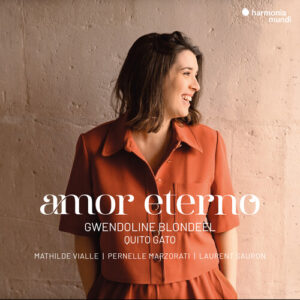
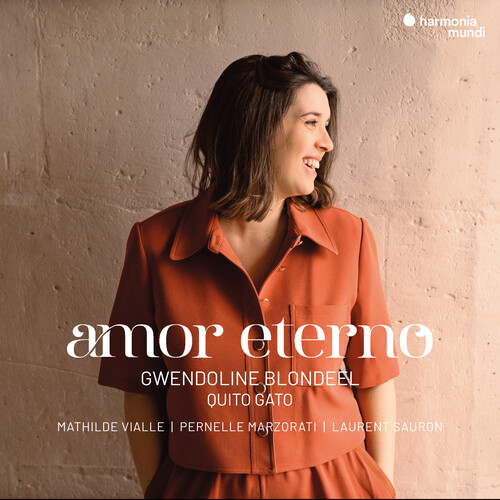
This new release with soprano Gwendoline Blondeel and lute and vihela performer Quito Gato is dedicated to villanelles, madrigals, and love songs from 15th to 17th century Spain, France and Italy.
NOTE: All of the music on this program comes from a recording featuring Gwendoline Blondeel, soprano, & ensemble directed from the vihuela, lute, & guitar by Quito Gato. It is on the Harmonia Mundi label and is HMM 902778.
Throughout the whole of Europe since the Middle Ages, up to and including our own time, musical practices and repertoires, whether popular or serious, profane or sacred, Christian, Jewish or Muslim, have been nurtured by mutual influences. Many melodies have passed from one culture to another in this way, so that in many cases their original source cannot be precisely determined. The kind of music most liable to undergo such transmigrations has been the music of love – undeniably a universal emotion, and one that aspires to the eternal: a feeling inherent in all human beings, but inseparable from the divine.
Amor sacro, amor profano
At the end of the 15th century, the songs of Josquin Desprez (whose music the important Swiss theoretician Heinrich Glarean acclaimed as fully meriting the term ars perfecta) bear witness to this general movement of genres, forms and styles. The popularity that chansons had enjoyed earlier on at the illustrious court of Burgundy, under Philip the Good and Charles the Bold, still prevailed. The melancholy, bitter tone of the songs reflects that of their poetry, which deals for the most part with disenchanted love, a feeling that permeates the sombre polyphonic settings of Josquin’s Adieux mes amours and particularly of his Mille regretz, a song originally for four voices that was such a favourite of the great-grandson of Charles the Bold, the Emperor Charles V, that it was dubbed the ‘Canción del Emperador’. Its fame led to its being variously transformed: in 1536 Cristobal de Morales used its polyphonic material to construct an entire Mass, while Luis de Narvaez adapted it for the vihuela – the same instrument Alonso Mudarra employed in his Seville publication of 1546 (Tres libros de música), to accompany a song evoking the sadness of King David, whose favourite instrument was the harp.
Since the dawn of the Renaissance the celebrated Mantovana, also known as the Ballo di Mantova, had been a kind of musical coat of arms for the dynasty of the Gonzagas, the Dukes of Mantua. This charmingly nostalgic melody has its origin in a Hebrew prayer going back to the 15th century, Birkat Ha’tal: the Sephardim presumably took it with them when they left Toledo. Popularised by the Jews of Mantua (among them the eminent composer Salomone Rossi), it soon became the emblematic tune of the lakeside city of Mantua. In 1600 the singer Giuseppe Cenci, also known under the name of Giuseppino del Biado, joined the air to a poem of madrigalesque gallantry, ‘Fuggi da questo cielo’, giving it the form of a canzonetta for voice and basso continuo. In 1607, the highly reputed Claudio Monteverdi, who had been in the service of the Gonzagas since 1590, transformed it into a brilliant major-key Toccata for the opening music to his first Mantuan opera, L’Orfeo; three years later he redeployed it for a religious work, as the introductory versicle of his Vespers for the Blessed Virgin.
Crossing several frontiers, it re-emerged (in both major and minor tonalities) in various popular traditions, in all the four corners of Europe. It even became a Czech nursery rhyme, Kočka leze dírou, that Smetana integrated into his famous Moldau symphonic poems, and finally in 1945 it gave birth to the Israeli National Anthem, Hatikvah.
Musica poetica
As a consequence of the new ‘courtly manners’ advocated by Baldassare Castiglione in his Book of the Courtier of 1528, Renaissance poetry went through some important changes in European countries of quite different cultures. In France, the accession to the throne in 1515 of Francis I coincided with the emergence of a new literary sensibility that crystallized around the poets of the ‘Pléiade’, such as Ronsard, Du Bellay and Baïf, exemplified in the ‘Parisian’ chanson, of which Clément Janequin was the unchallenged master. The refined elegance of Ce moys de may illustrates this poetic and musical development in the secular chanson, confirmed in a lighter register by the mirthful irony of Je ne l’ose dire by Pierre Certon.
In Italy, the genre of the madrigal that had first appeared in Tuscany at the dawn of the 14th century underwent a revolutionary change two hundred years later. The verses of Giambattista Guarini (1538-1612), Torquato Tasso (1544-1595) and Gabriello Chiabrera (1552-1638), full of striking images and burning passions, came to inspire composers to write music of unprecedented daring. Within a few years their madrigals had supplanted the frottole, villote and other canzone, and for the next hundred years and more it became the poetic-musical genre that was most enjoyed south of the Alps.
And not only there: in 1597, in his treatise A Plaine and easy introduction to Practicall Musicke, the English composer and theoretician Thomas Morley defined it thus:
‘[As to] the light music, […] there is no vanity which in it hath not been followed to the full, but the best kind of it is termed Madrigal, a word for the etymology of which I can give no reason. Yet use showeth that it is a kind of music made upon songs and sonnets such as Petrarch and many poets of our time have excelled in […] It is, next unto the Motet, the most artificial 1 and, to men of understanding, most delightful.’
Harmonia aeterna
Originally written for four or five voices, the madrigal gradually used fewer and fewer. For instance, while Chiabrera’s poem Damigella tutta bella was first set for three voices by Monteverdi in his Scherzi musicali of 1607, ten years later Vincenzo Calestani used the same words for an accompanied monody that he published in his Madrigali ed arie. Monteverdi himself eventually gave up this this recent fashion for madrigali ed arie a voce sola, publishing instead subtle canzonette for solo voice and basso continuo. His sweetly-toned Si dolce è il tormento, one of his most famous pieces, appears in an anthology featuring several composers, Quarto scherzo delle ariose vaghezze, published in Venice in 1624 by Alessandro Vincenti. Meanwhile, in his earlier, skilfully-crafted Nuove musiche, the Florentine singer and composer Giulio Caccini had presented charming strophic songs such as Belle rose porporine, lending a joyous dancing rhythm to this music of universal charm.
Genres derived from the madrigal include the villanella, originally from Naples, which adopted a simpler, even a popular tone. Generally written for three voices, by the beginning of the 17th century its boundaries with the canzonetta became blurred, as testified by the works by Girolamo Kapsberger for solo voice and basso continuo, such as the gentle lullaby Figlio, dormi and the serenely smiling Già risi, which the Rome-based lutenist published in 1619 and 1623 in his Second and Fourth Book of Villanelles.
Amor divino e humano
At the turn of the 17th century, the French poets, following the example of Giambattista Marino (1569-1625), introduced a new literary aesthetic, stimulated by ‘Astree’ (1607), Honoré d’Urfé’s renowned novel of stories within stories. Their poetry combined the bucolic and the galant with a mannered preciosity. Likewise, the courtly airs that had flourished during the Valois monarchy gave way under the Bourbons to the more up-to-date airs sérieux (serious airs), as well as drinking songs, which remained in fashion until the Regency (1715-1723). During this period the Ballard family, a Parisian dynasty of music printers, greatly increased their flow of publications, often devoted to a single successful composer, such as Honoré d’Ambruis (a pupil of Michel Lambert); in 1685 they issued d’Ambruis’ Livre d’airs avec les seconds couplets en diminution mesurez sur la basse continue. Yet music lovers enjoyed still more the anthologies that included several composers. Among them occasionally some famous names crop up, such as François Couperin – or Marc-Antoine Charpentier, two of whose songs were printed by Ballard in 1703 and 1704, one of them being Feuillages verts, naissez.
In Spain around the same time, the traditional taste for cancioneros, rekindled by the songs of Juan del Encina and Juan Vasquez, gave way first to tonos divinos (sacred songs), then to the tonos humanos or tonadas (secular songs). José Marín, a composer who had a swashbuckling youthful past behind him (he had been accused of murder), but ended up living an exemplary life, was one of the most famous composers of his time, leaving behind him around sixty songs with guitar or basso continuo accompaniment. At his death, the Gaceta de Madrid paid him a moving tribute, recalling that ‘he was known, both in Spain and abroad, for his rare skills as a composer and performer.’
DENIS MORRIER
MARC-ANTOINE CHARPENTIER (1643-1704) (2'55) · Feuillages verts, naissez H. 449a (Brunettes, Livre 2, Paris, 1704)
VINCENZO CALESTANI (1589-after 1617) ·Damigella tutta bella (Madrigali ed arie, Venice, 1617) (2'46)
CLAUDIO MONTEVERDI (1567-1643) · Sì dolce è’l tormento SV 332 (Quarto scherzo delle ariose vaghezze, Venice, 1624) (2'57)
ALESSANDRO PICCININI (1566-ca. 1638) · Chaconne (Intavolatura di liuto et di chitarrone, Libro 1, Bologna, 1623) (2'39)
GIUSEPPINO DEL BIADO (d. 1616) · Fuggi da questo cielo (La Mantovana) (2'11)
JUAN VÁSQUEZ (ca. 1500-ca. 1560) De los álamos vengo (Canciones i Villancicos, Seville, 1560) (1'57)
JOSQUIN DESPREZ (ca. 1450-1521) · Mille regretz (1'58)
GIOVANNI GIROLAMO KAPSBERGER (ca. 1580-1651) · Già risi (Villanelle, Libro III, Rome, 1619) (3'59)
MARIN MARAIS (1656-1728) · Prelude in D minor (0'37) · Fantaisie in D minor (Pièces de viole, Livre 1, Paris, 1686-1689 - Suite No. 1 in D minor) (0'55)
ANONYMOUS · J'avais cru qu'en vous aimant (Brunettes, Livre 1, Paris, 1703) (3'46)
FRANCESCO SPINACINO (fl. 1507) · Adieu mes amours (after the madrigal by Josquin Desprez) (2'45) (Intabulatura de lauto, Libro I, Venice, 1507)
GIOVANNI GIROLAMO KAPSBERGER · Figlio, dormi (Villanelle, Libro II, Rome, 1619) (4'32)
GIULIO CACCINI (1551-1618) · Belle rose porporine (Le nuove musiche, Florence, 1602) (2'22)
JOSÉ MARÍN (1618-1699) · Al son de los arroyuelos (Tonos Humanos, Cuenca, 1699) (3'02)
MARIN MARAIS · La Paysane (Pièces de viole, Livre 1, Paris, 1686-1689 - Suite No. 2 in D major) (1'08)
CLÉMENT JANEQUIN (ca. 1485-1558) · Ce moys de may (31 Chansons musicales a quatre parties, Paris, 1529) (2'04)
PIERRE CERTON (ca. 1510-1572) · Je ne l’ose dire (Pierre Attaignant, Troisième livre contenant XXVIII chansons, Paris, 1538) (2'31)
JUAN DEL ENCINA (1468-ca. 1529) · Fata la parte (Cancionero Musical de Palacio, Madrid, 1890) (2'22)
LUIS MILÁN (ca. 1500-ca. 1561) · Sospirastes, Baldovinos (Libro de música de vihuela de mano intitulado El Maestro, Libro 1, Valencia, 1536) (3'50)
VINCENZO CAPIROLA (1474-ca. 1548) · Ricercata XI alla spagnola (Libro di intavolature per liuto, Venice, 1517) (1'39)
ALONSO MUDARRA (ca. 1510-1580) · Triste estava el Rey David (Tres libros de música en cifra para vihuela, Seville, 1546) (2'28)
DIEGO ORTIZ (ca. 1517-ca. 1576) · Recercada segunda sobre el passamezo moderno (Tratado de Glosas, Rome, 1553) (1'31)
HONORÉ D'AMBRUIS (ca. 1660-ca. 1702) · Le doux silence de nos bois (Livre d'airs de différents auteurs, Book XIII, Paris, 1670) (5'51)