Program: #26-06🏆 Air Date: Feb 02, 2026
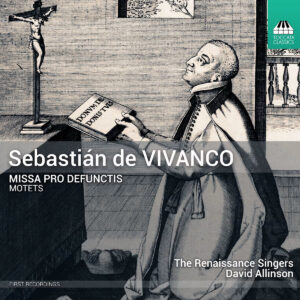
The Renaissance Singers (who celebrated their 80th anniversary in 2024) have a new release of world-premier recordings dedicated to this Spanish Golden Age composer.
Next: ⮞ #26-07 🔒🏆Amor Eterno
NOTE: All of the music on this program comes from The Renaissance Singers directed by David Allinson. The recording is on Toccata Classics and is TOCC 0770.
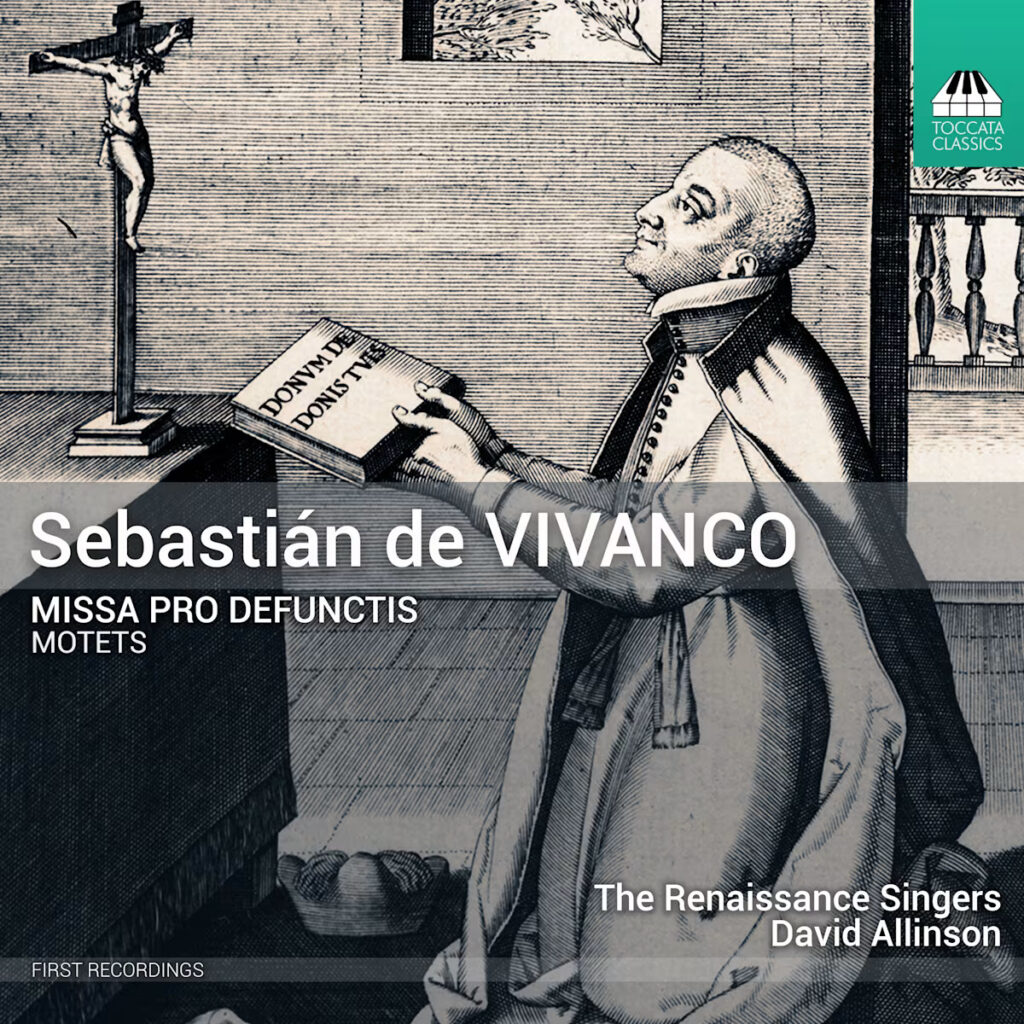
Spanish Renaissance polyphony has a reputation for florid, intricate contrapuntal textures and dark colours. Sebastián de Vivanco (c. 1551–1622), born in Ávila but active for most of his life in Salamanca, stands apart from his contemporaries: his music explores a much wider range of colours and techniques than that of, say, Victoria. In his more experimental and dramatic motets, some of which are heard here, he points the way towards the new Baroque. But in the calm sobriety of his Requiem, now reconstructed and recorded for the first time, he honours the Iberian tradition of unhurried chant-driven polyphony, all the more moving for its uncluttered clarity and exquisitely lovely chordal sequences
Whose Requiem is it anyway?
Imagine this. You’ve taken your seat in the concert hall for a performance of a Requiem: Verdi perhaps, Brahms, or maybe Fauré. But the conductor turns to the audience with an announcement. Apparently, this piece exists in different versions, and it’s unclear which of them the composer wanted us to hear. The musicians will therefore perform parts of the work twice.
If this scenario seems unlikely to you, it shows that you tend to think of most composers’ works as being fixed, made stable by a set of published musical symbols. We assume the music represents the composer's final thoughts at whatever point the clock was stopped – and usually within the composer’s lifetime.
In Renaissance music this isn’t always the case. The printing press did revolutionize the dissemination of vocal music throughout the period, and we are fortunate to have printed collections by many great composers. But much of what was sung in cathedrals then was transmitted in manuscript copies. It was the use and re-use of the music, not its written structures, that mattered: music would be adapted, rewritten or discarded in different locations to suit the particular circumstances of the institution and the choir. And sadly these manuscripts were easily damaged, lost or deliberately discarded.
For musicians today the result can be a blur, a musicological puzzle. How might we fit together the ‘work’ from the sources available? Should we even try to second-guess the composer’s intentions, or should we embrace the instability of multiple, open-ended solutions?
This explains how my choir, The Renaissance Singers, came to perform and record some movements of a Requiem twice.
Rediscovering a Requiem by a great composer
The Missa pro defunctis by Spanish composer Sebastián de Vivanco was once thought to be lost, or to exist only in fragments. Vivanco published three substantial printed collections of his music between 1607 and 1610, but those did not include the Requiem. It survived tenuously in two manuscripts—in the Spanish cities of Guadalupe and Ávila—that were copied many decades after Vivanco’s death in 1622.
The new edition we sang was created by the brilliant musicologist Jorge Martín, who has reconstructed the piece from these manuscript sources. Music that was clearly not by Vivanco has been removed. Elsewhere, the transmission and use of Vivanco’s music in different Spanish cathedrals has created parallel versions of some sections, and rather than attempting to resolve or suppress the disparities, we embraced them. Thus we included two versions of the Kyrie and the Sanctus where the manuscripts differ. Which of them is closest to the music Vivanco originally conceived may never be known.
When we performed this Requiem in June last year, a 21st century audience was hearing portions of this music—and all that is unknowable about its history—for the first time.
A first recording
There’s an especially rich seam of emotionally intense sacred music from Renaissance Spain. Vivanco’s Requiem belongs to a tradition of Iberian Requiem settings by Morales, Guerrero, Cardoso, Duarte Lobo and many others – most famously Victoria. Those have all been recorded, sometimes many times over, but Vivanco’s was missing from that canon.
Until now. Last July, when most people were sensibly avoiding the heatwave, we spent three intense days recording the Missa pro defunctis in central London, together with motets by Vivanco and his Spanish contemporaries.
Vivanco’s music is superb: elegant, fluid and luminous. He stands at the end of a great tradition of Spanish Golden Age polyphony, but his intensely expressive use of harmony and small motivic details seem to point towards a more baroque style.
The choir for which Vivanco originally conceived this music is likely to have been all male. As we are a modern, mixed-voice choir we sing the piece at a pitch that works for our forces. Our aesthetic approach was to avoid an overly serene or detached style of singing, but instead to bring to the work a sense of narrative and human connection; this music is dramatic, consoling and humane.
One of the joys of working in the field of Renaissance music is that new discoveries are always possible. Our sense of what’s canonical is often shaped by arbitrary historical forces, or by what previous generations found useful to include in anthologies for choirs. But it’s always changing, because there is still great music out there that we haven’t heard.
Vivanco’s Requiem has come a long way to be here. It was written over four hundred years ago to pray for the souls of the departed during Mass; copied by hand and taken to different cities in Spain; used, adapted, and then neglected, forgotten and unheard for centuries.
Cristóbal de Morales
- Circumdederunt me gemitus mortis a5 (2:17)
Sebastián de Vivanco
- De profundis clamavi a4 (2:49)
- Parce mihi, Domine a4* (3:59)
- Versa est in luctum a6 (4:54)
- Manus tuae, Domine a4 (2:52)
Missa pro defunctis a4 (24:39)*
- I. Introit. Requiem æternam (5:27)
- II. Kyrie eleison (Guadalupe version) (1:33)
- IIb. Kyrie eleison (Salamanca version) (1:45)
- III. Tract. Absolve, Domine (2:53)
- IV. Offertory. Domine Jesu Christe (3:59)
- V. Sanctus – Benedictus (Guadalupe version) (3:58)
- Vb. Sanctus (Salamanca version) (2:17)
- VI. Agnus Dei (2:47)
- Circumdederunt me dolores mortis a5 (4:25)
- O Domine Jesu Christe a5** (3:05)
Bernardino de Ribera
- Dimitte me ergo a6 (3:55)
Juan Guitiérrez Padilla
- Circumdederunt me dolores mortis a6 (5:09)
Melchor Robledo
- Salve Regina a6 (7:54)
Next: ⮞ #26-07 🔒🏆Amor Eterno