Program: #26-38🏆 Air Date: Sep 14, 2026
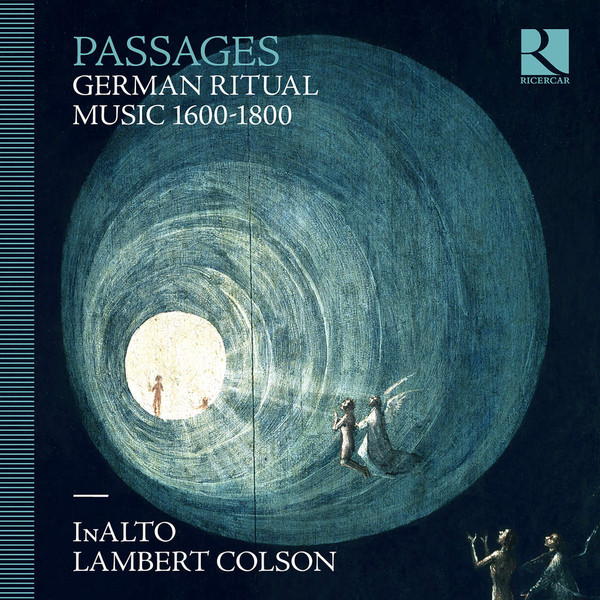
Catching up with this Belgian-based ensemble, we come next their examination of German Ritual Music 1600 to 1800 in recording called “Passages."
This program is part of a special series.
Continued from: ⮜ #26-30 🔒🏆Tarquinio Merula
Continues in: ⮞ #26-43 🔒🏆Ensemble InALTO, Part 3
Next: ⮞ #26-39 🔒🏆Friederike Chylek, Part 1
NOTE: All of the music on this program is from the recording Passages (InALTO/Lambert Colson). Ricercar RIC 443.
Primitive instruments with embouchures made from animal horns were traditionally used by hunters and shepherds for summoning and signalling. In cultures and traditions throughout the world, their distinctive sound is often associated with ritual, rites of passage – funeral rites, births, weddings, and ceremonies connected with the setting sun – and even magic. Such traditions have existed since the dawn of time. Two silver trumpets were found in Tutankhamun’s funeral chamber. In the Apocalypse of John, seven angels sound trumpets, destroying the physical universe and ushering in God’s eternal kingdom. The Qu’ran describes an angel, traditionally identified as Israfil, who sounds a trumpet before the end of time, thus heralding the resurrection of the world. Centuries later, Luther translated these “trumpets” as Posaunen, that is, “trombones”.
From the sixteenth century onwards, brass ensembles continued to play an important role in sacred music, particularly in the German-speaking lands. Composers used brass instruments to evoke hell, death, and the passage to the afterlife. Schütz chose trombones to portray King David’s grief at the death of his son Absalom. Composers at the imperial chapel in the seventeenth century, such as Christoph Strauß, Giovanni Valentini, Antonio Bertali, Johann Heinrich Schmelzer, and Johann Joseph Fux, frequently used mute cornetts for funeral pieces. In his motet O Jesu Christ, meins Lebens Licht (BWV 118), J. S. Bach called for an ensemble almost archaic beyond measure in eighteenth-century Germany, consisting of a cornet, three trombones, and two litui, mysterious “horns”. Composers such as Praetorius, Schütz and Schein also used brass for other kinds of passages: birth, marriage, and resurrection, thus tracing the entire circle of life. This tradition was still familiar to, Beethoven who composed three Equali for four trombones in the purest musical tradition, to be played at Linz cathedral on All Soul’s Day 1812, without knowing themusic would be arranged by Ignaz Ritter von Seyfried for his own funeral fifteen years later.
InAlto presents a selection of music for brass and voices from Lassus to Beethoven – including music by Becker, Scheidt, Schütz, Buxtehude, and Bach – in a programme of emotional intensity and spiritual profundity.
- Equale Nr. 1 (Miserere), WoO 30
- Equale Nr. 3 (Amplius), WoO 30
- O Meine Seele, Warum Bist Du Betrübet, SWV 419
- Freudenlied
- Fili Mi Absalon, SWV 269
- Paduana Dolorosa, SSWV 42
- Klage-Lied, BuxWV 76/2
- Da Der Tag Ein Ende Nahm
- Aurora Lucis Rutilat
- Du, Dem Nie Im Leben Ruhstatt Ward
- Ch Bin Eine Blume Zu Saron
- Haec Dies
- O Jesu Christ, Meins Lebens Licht, BWV 118
- O Jesulein, Mein Jesulein
- Traur- Und Begräbnuß-Music Des Herrn Johann Helms
- Herzlich Tut Mich Verlangen, BWV 727
- Freue Dich Des Weibes Deiner Jugend, SWV 453
This program is part of a special series.
Continued from: ⮜ #26-30 🔒🏆Tarquinio Merula
Continues in: ⮞ #26-43 🔒🏆Ensemble InALTO, Part 3
Next: ⮞ #26-39 🔒🏆Friederike Chylek, Part 1