Program: #26-39🏆 Air Date: Sep 21, 2026
The German-born harpsichord soloist (and English music specialist) sent along her many recordings; we sample the early ones including an early collaboration with Simon Standage.
This program is part of a special series.
Continues in: ⮞ #26-44 🔒🏆Friederike Chylek, Part 2
NOTE: All of the music on this program features recordings by harpsichord soloist Friederike Chylek. For complete information:
1. Italians in London! (with Simon Standage, violin). Chaconne CD CHAN 0806.

From Classical a la Carte: There are so many violin sonatas by Italian composers from the first half of the 18th century that mixed anthologies such as this can seem the most sensible way of giving them a chance. Focus here is provided by concentrating on some of the numerous Italian violinist-composers who made a living at one time or another in ever-receptive London. Starting with Nicola Matteis, who first dazzled English audiences in the 1670s, it ranges on through Geminiani, Visconti and Carbonelli (who as pupils of Corelli were bound to go down well in England), takes in Veracini and the leader of Handel’s opera orchestra Castrucci (both individuals thought by Englishmen at the time to have been at least a little mad), and ends with Giardini, brilliant leader of the orchestra at the King’s Theatre (and with Abel and JC Bach one of the apostles of the galant style in London). Matteis, Geminiani and Veracini are already moderately well represented in the catalogue, the others less so, and this disc claims six premiere recordings. With the exception of Geminiani’s Auld Bob Morrice, nothing here seems to have been touched by any particular kind of Britishness unless it be in an overall tendency towards elegance and restraint; what quirks there are are mild ones. All this finds a match in the playing of Simon Standage, a veteran of the beginnings of British period performance whose essentially delicate sound is nourished by easy bowing and sweet but unobtrusive vibrato. Showiness is not for him and he seems happier when letting this music’s clean lines speak for themselves, with just a little nurturing, than in passages of more extrovert or high-lying virtuosity, where a hint of discomfort sometimes creeps in. Friederike Chylek likewise eschews flashy continuo in favour of something more modestly functional, though her renderings of three Scarlatti sonatas are little pockets of controlled energy.
2. Time stands still. Oehms Classics OC 1864.

From Early Music Review: Father Christmas was kind to me, dropping three superb discs down our chimney into the wood-burner: an astounding record of Chicago blues covers by The Rolling Stones; Terry Riley’s fabulous Keyboard studies #2; and Quire Cleveland’s luminous live recording taken from two concerts devoted to Byrd that they gave last spring in Cleveland and Akron, OH. So I was well equipped for good listening throughout the festive period. However, the very day that postal deliveries resumed after Christmas, a package containing the record under review here dropped through our front door. Riches upon riches?
Yes, or perhaps Ja, because this is an assertively Anglophile recording, played by a German harpsichordist on a German copy of a 1624 Ruckers instrument, released on a German label, with booklet notes written by a German musicologist who derides his fellow countrymen’s notion of England as a “Land ohne Musik”. Naturally, much of his contempt is based on what he perceives as the excellence of the virginalists, led by Byrd, and of Purcell. There is plenty of music by both these composers on this disc, and the entire contents are played superbly. I have only two reservations about the presentation. First, the list of items on the back of the sleeve is not identical with the order in which they appear on the recording, for which one has to refer to the booklet. Nevertheless it is still an inviting menu. Secondly, although the booklet notes are good as far as they go, more information about the individual pieces would have been welcome: for instance, one of the best pieces on the disc in terms of both quality and performance is Giles Farnaby’s setting of a Pavan by Robert Johnson. Presumably Johnson’s original version was for the lute. It would have been interesting and useful to have been told that this has not survived. It has been conjecturally reconstructed by Nigel North and can be heard being played by him on his disc Robert Johnson: The Prince’s Alman, and other Dances for the Lute (Naxos 8.572178, 2010).
Ms Chylek begins with an item from the left field of Byrd’s oeuvre, the Prelude in F which survives anonymously but which Oliver Neighbour authoritatively ascribed to Byrd. Only an incipit is included in Alan Brown’s complete edition of Byrd’s keyboard music (BK 115) and a full text can be found in volume 55 of Musica Britannica, in which it is number 3 on page 2. Part of Neighbour’s proof that it is by Byrd is its similarity to parts of Byrd’s Pavan and Galliard also in F, dedicated to Ph[ilippa?]. Tr[egian?]. However, the opportunity to include this fine pairing is overlooked. After an anonymous Galliard from the Mulliner Book, there is more Byrd, with My Ladye Nevell’s Ground followed by his setting of Dowland’s Lachrymae Pavan, followed by two short pieces from the Fitzwilliam Virginal Book: an Alman by Robert Johnson, and Giles Farnaby’s Paul’s Wharf. The focus then shifts to Purcell, with his Suites in G minor and A minor, Z 661 and 663, bookending four short miscellaneous pieces, and being followed by two more. Byrd reappears with his La Volta BK 91, which is followed by the longest work on the disc, Tomkins’ Ground, and the recording closes with two arrangements with differing provenances: Johnson’s Pavan (see above) set by Farnaby; and Dowland’s song (and title track) Time stands still arranged for the harpsichord by the artiste, Friederike Chylek.
It is a pleasure to emphasize that throughout the recital Ms Chylek’s playing is immaculate and her interpretations judicious. She respects the composers’ creativity in the longer and potentially repetitive pieces such as the Grounds by Byrd and Tomkins by responding to the subtle structures and varied textures that mark these out as the products of musicians who are great and not merely good. Meanwhile she can make a brief work such as the Corant from Purcell’s Suite in A minor just as memorable by illuminating how Purcell incorporates a wonderful melody without destabilizing the piece as a whole. Similarly she relishes Byrd’s almost torrential varied repeats in his Pavana Lachrymae while treating Farnaby’s setting of Johnson’s delightful and pensive Pavan with the utmost delicacy. Her arrangement of Dowland’s song could seem incongruous but one imagines that she wished to illustrate that in the work of the English virginalists, time can indeed stand still, so this is her homage to these incomparable composers.
Richard Turbet
3. From Byrd to Byrd. Oehms Classics OC 1702.
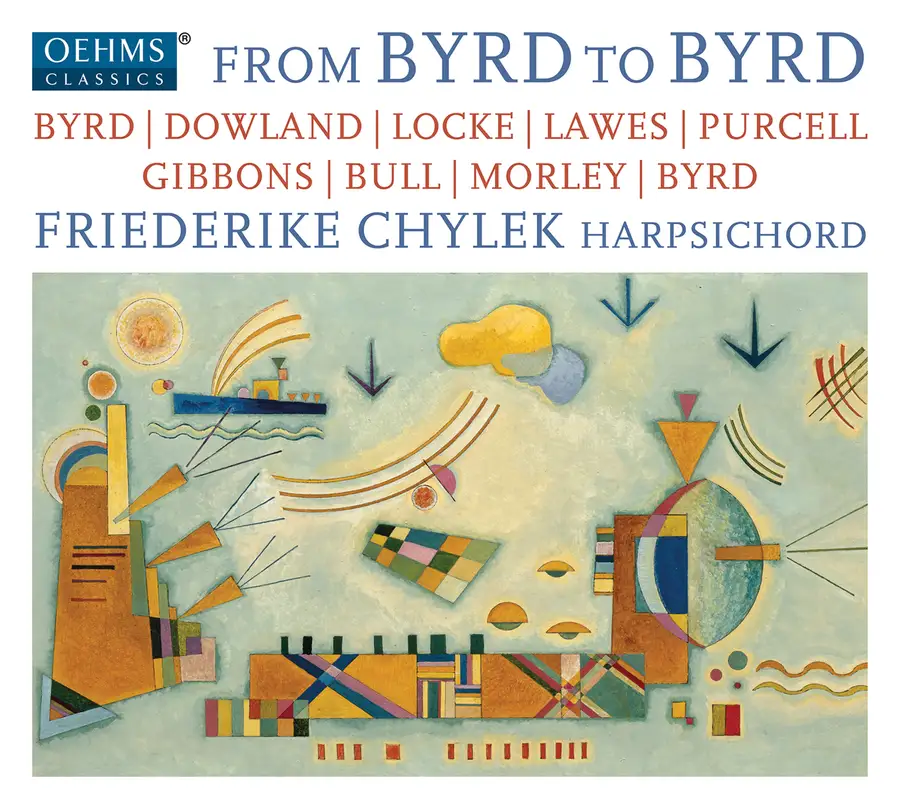
From Early Music Review: This is the second recording by the German harpsichordist Friederike Chylek of early English keyboard music. I gave Time Stands Still a warm welcome (7 February 2017) and so I began listening to its successor with a sense of eager anticipation. The programme is built around a fascinating conceit, somewhat in the form of a rondo, featuring Byrd as fons et origo of harpsichord music, with forays into the works of his pupils and, further afield, to composers from the seventeenth century all of whom benefited from his pioneering. The disc is given a particular significance for including a rare Byrd premiere, of sorts.
The programme begins with four varied pieces by Byrd himself, beginning with The Bells. There are over twenty versions of this classic currently available, and more than one of the recent procession of releases featuring Byrd’s keyboard music have included it. Nevertheless, even a jaded palate will be stimulated by Chylek’s superb performance. I was brought up on Fritz Neumeyer’s version (on a 10” LP from 1957!) which pulled off the trick of being metronomic while allowing Byrd’s music to express how he had been inspired by the sound of pealing bells. Frau Chylek goes further, maintaining an ideal balance between the disciplined requirements of campanology, and a subtle ebb and flow as Byrd revels in the ringing. Some recordings tend to over-interpret this piece. Chylek confirms that the only requirements are the composer’s notes, allied to the performer’s momentum and sensitivity. The other three items in this opening section are Byrd’s first setting (of three) of Monsieur’s Alman; Lord Willoughby’s Welcome Home – always welcome (sic) especially when played as vivaciously as this; and the Prelude in G which is the first item in the volumes of Musica Britannica devoted to the composer.
It might seem perverse to conclude what is obviously a separate section of a recording with a prelude, but in fact it leads fittingly to an anonymous setting of Dowland’s Piper’s Pavan & Galliard (MB 96/28) which is in the same key. This is followed by the disc’s significant premiere. There is an LP recording of the setting of Piper’s Galliard aka If my Complaints, played by Paul Maynard, from 1962, but this is the first version on CD, providing an interesting comparison with the anonymous setting of the same galliard that is the previous track. The attribution to Byrd in its unique source is now universally rejected (BK 103, MB 96/38) not least because yet another anonymous setting (Tuttle 26, BK 118, MB 55/20) is now regarded as likely to be by Byrd, and has been recorded as such by Davitt Moroney on his boxed set of Byrd’s complete keyboard music (Hyperion CDS44461-7) and by Aapo Hakkinen on William Byrd: Late Music for the Virginals (Alba ABCD 405) which I reviewed appreciatively for EMR (published 20 November 2017 q.v.). Although Frau Chylek makes the best possible case for the amiable setting now rejected from Byrd’s keyboard canon, it is not difficult to agree with Oliver Neighbour’s dismissal of it as “a thoroughly amateurish version” of Dowland’s galliard, even going on to call the attribution to Byrd “impertinent”. The piece is not mentioned by Martin Hoffmann in the booklet, and is described accurately and with restraint on the sleeve as “arr. attributed to Byrd”. Incidentally, according to Stephen Tuttle and pace Moroney, the now accepted anonymous setting was first attributed to Byrd as early as 1929, by Hilda Andrews in part II of the Catalogue of the King’s Music Library (London: British Museum).
We remain with Byrd for his second setting of Monsieur’s Alman which is the longest of the three (the brief third is on Hakkinen’s disc mentioned above; Neighbour was wrong to be dismissive of these settings, as Chylek and Hakkinen give thoughtful performances that answer his criticisms) before setting off for the Baroque. Here we are treated to a Suite in D by Matthew Locke from Melothesia, then a Symphony and Saraband in g by William Lawes, numbers 48-49 from Playford’s Musick’s Handmaid of 1663 (numbers 343 and 345 in the Viola da Gamba Society’s Thematic index of music for viols under William Lawes), followed by the Suite in d (Z 668) by Purcell; the subtitle of the almand “Bell-barr” refers to Bell Bar, a hamlet in the parish of North Mimms or Mymms in Hertfordshire, close to Hatfield and St Albans. Chylek’s touch in these tuneful Baroque items is as sensitive to her material as it is in the earlier pieces from the Renaissance.
And then it is back to Byrd again for three more works. The Pavan & Galliard pair “Bray” is thought to be dedicated to the expatriate Jesuit priest Fr William Bray. It is one of Byrd’s less recorded pairings in its original version for keyboard, the pavan being more likely to crop up on disc, minus its exquisite varied strains, in its arrangement for lute by Francis Cutting. The third work in this section is Byrd’s Fancy for My Lady Nevell aka Fantasia in C (BK 25) which begins with an upward scale of C major which, as I have suggested in previous reviews in EMR,echoes Byrd’s setting of the word “lux” in his motet Descendit in coelis from his second book of Cantiones sacrae 1591. Her execution of “Bray” captures the character of what is among Byrd’s more pensive, and most beautiful, pavans, while she captures the sheer tunefulness of the galliard, not least in its second strain where there is one of Byrd’s delightful sleight-of-hand key-changes towards the end. Nor is her response to what is one of Byrd’s most performed fantasias at all like the usual cavalry charge with which it can be despatched, again preferring a pensive approach to show the piece in a different light.
After this return to Byrd, we are off again, this time to his more immediate successors. First, Gibbons’ Mask: The Fairest Nymph, a miniature that transcends it miniaturity, if there be such a word. Dowland is then revisited, in two settings by Bull of Piper’s Galliard, both of them effervescent, the second like a shower of musical meteorites. Chylek abides as distantly as possible by Thurston Dart’s pronouncement – solemnly echoed by most subsequent performers and editors of this piece – that “the formidable brilliance of this setting enforces a slow tempo”, without sacrificing any musicality, a thrilling account. Morley’s very C-major Alman goes some way towards slamming the brakes on, though even here the varied strains throw caution bracingly to the winds, as the disc approaches its final item, Byrd’s Hornpipe.
In Byrd’s day the hornpipe was a dance in triple time that could be either fast or slow. It had no nautical connotations until the eighteenth century, when it seems also to have begun to be danced in quadruple time. Byrd’s piece is structurally a ground, and incorporates both the slow and, from bar 121, fast manifestations of the dance. From a staid start, Byrd subtly winds up the musical action using syncopation and varied note values, until the change of tempo at bar 121, when it seems as though some source of extra creative energy bursts forth, such as younger and more energetic dancers taking over from more mature performers, with increasing terpsichorean elation. Or so Friederike Chylek’s playing could persuade one to believe.
This disc is a luminous justification of the concept of the long-playing record and the compact disc. It is beautifully constructed on two levels. First, it provides a programme in which interesting individual pieces are juxtaposed, meaning, for example, that the listener with a penchant for Byrd can be introduced to the superb music of Matthew Locke, who was born two years before Byrd died, with which they might not be familiar. Secondly the programming is inventive and sensitive. Byrd’s Prelude in g BK 1 concludes the opening section devoted to his music but it leads decorously into an anonymous setting, in the same key, of Piper’s Pavan & Galliard by Dowland. The galliard is followed by another setting, attributed – albeit probably wrongly but nonetheless interestingly – to Byrd. Later in the programme there are two dazzling settings by Bull of the same galliard, the second an even more spectacular “variatio” of the first. There are two settings of Monsieur’s Alman by Byrd to compare, and a hornpipe by him and another by Purcell also to compare. As I mentioned at the outset, the entire programme keeps flowing from Byrd to Byrd, interspersed with forays to those who were his pupils, and further afield to those influenced by him more distantly.
The booklet’s notes are an object lesson in informed enthusiasm. It seems churlish to mention that they still give the date of Byrd’s birth as 1543 (recte 1539/40) but this can be excused in view of Martin Hoffmann’s appreciative, almost evangelistic, focus on the repertory of this recording.
Neither the excellence of the programming nor of Dr Hoffmann’s notes would be worth much without the superlative quality of Friederike Chylek’s playing. With this recording her mere name becomes self-recommending. Her tempi are unerringly judicious, her faultless interpretations exuding profound sensitivity expressed lightly. She is aided by a fine instrument, copied by Matthias Griewisch from an original of 1624 by Ruckers. It has an almost silvery tone yet is strong when required, and depicts every note with clarity and appropriate emphasis, revealing individual lines within the more contrapuntal pieces while blending them into the totality of each piece. This is of course a compliment to Friederike Chylek’s technique.
I cannot recommend this disc too highly. Anyone familiar with some or all of these works will find them interpreted in so many new lights. It is also an ideal disc for someone setting out to discover early English keyboard music – a wonderful repertory complimented by this wonderful disc.
Richard Turbet
This program is part of a special series.
Continues in: ⮞ #26-44 🔒🏆Friederike Chylek, Part 2