Program: #26-27🏆 Air Date: Jun 29, 2026
This remarkable project with the Galilei Consort in collaboration with the Baroque Music Center at Versailles, presents the work commissioned in 1638 by Louis XIII for the birth (in Venice!) of the future Louis XIV.
NOTE: All of the music on this program is from the recording Messe pour la naissance de Louis XIV (Galilei Consort/Benjamin Chénier). Alpha 965.
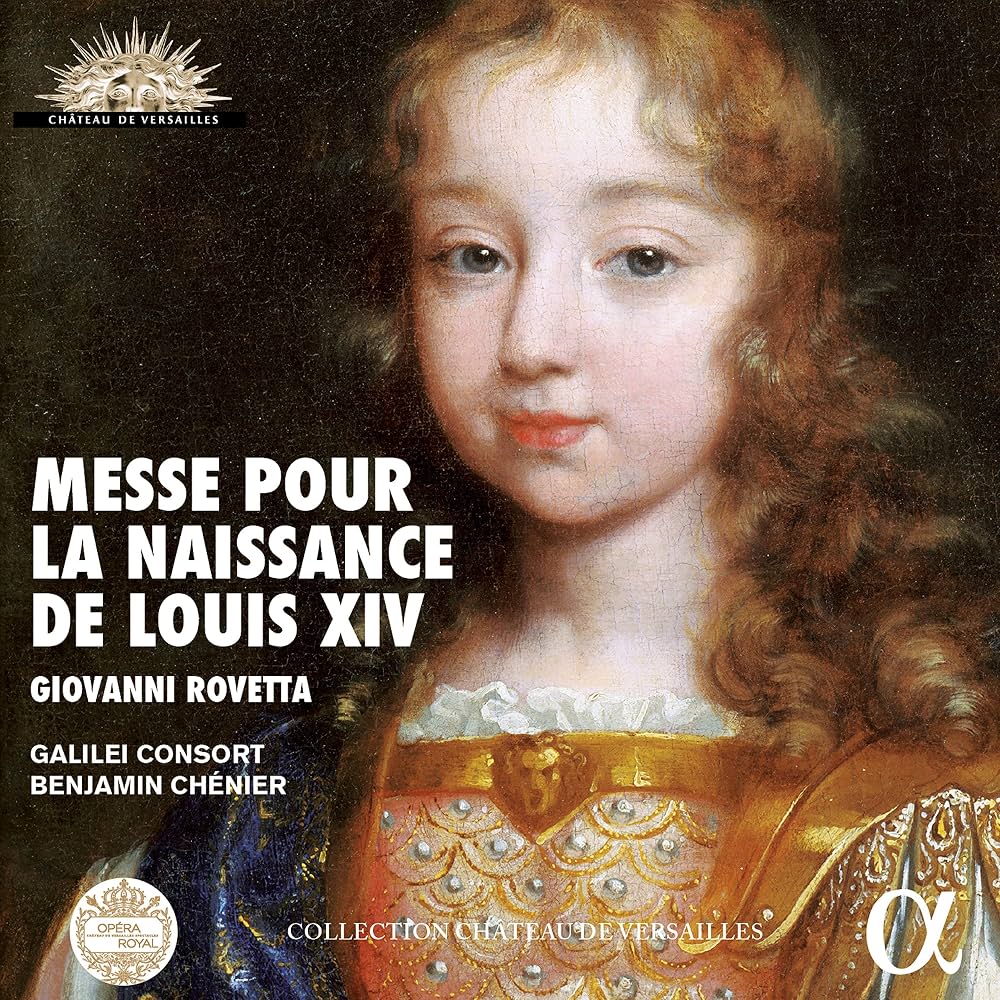
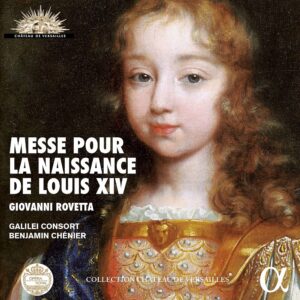
In 1638, Louis-Dieudonné, who became king of France under the name of Louis XIV, finally came into the world. Louis XIII instructs his ambassadors to celebrate the event with pomp. In Venice, whose commercial vitality dominates Europe, four days of the festivities are organized to the glory of the Dauphin, crowned by the execution in San Giorgio Maggiore of a solemn Mass specially composed by Giovanni Rovetta, deputy chapel master of Monteverdi in San Marco, who will succeed him in 1644 and become one of the unmissable musicians of Venice. Never replayed since its creation, this Mass was returned by Benjamin Chénier in 2015, for the Tricentenary of the death of Louis XIV. A grandiose work, it is typically Venetian with all the pomp of its own to the spirit of the Serenissima Republic. The Galilei Consort, founded by the violinist Benjamin Chénier, is dedicated to the restitution of practices and works of the 17th century Italian mainly. Practices stemming from the humanist current personified by Vincenzo Galilei, father of the famous Galileo, who advocates a return to the Greek conception of music, a conception that emphasizes the meaning of the text.
A birth is always a significant event. When it involves an heir to the throne, it inevitably becomes a cause for celebration throughout the kingdom. The circumstances surrounding the birth of the future Louis XIV made it a particularly long-awaited occasion. Louis XIII, married to Anne of Austria since 1615, had produced no offspring in over twenty years of marriage. Moreover, both the King and Queen were past the age of thirty-five—a relatively advanced age given the average life expectancy of the time. In 1637, the King had placed his realm under the protection of the Virgin Mary to more surely invoke the birth of an heir. Meanwhile, Monsieur—the King’s brother—already envisioned himself succeeding his ailing brother on the throne...
On January 30, 1638, the miracle occurred: Anne of Austria gave birth to the young Louis-Dieudonné. Te Deums were immediately sung in Paris, where cannons were fired to signal the public rejoicing. Louis XIII also instructed his ambassadors to organize celebrations in their host countries—though not without political calculation: this event within the royal family was an opportunity to showcase the grandeur and power of the Kingdom of France abroad. Against this backdrop, Hamelot de la Houssaye, the French ambassador to Venice, commissioned works from the Serenissima’s greatest composers; Giovanni Rovetta, vice-choirmaster at St. Mark’s since 1627, was asked to compose a mass in honor of the Dauphin. The great Claudio Monteverdi also contributed, as did Giovanni Antonio Rigatti—a priest, singer, and composer associated with St. Mark’s.
In November 1638, this mass served as the highlight of lavish celebrations spanning four days. Some sixty gondolas—carrying the Doge, his wife, the ambassador, and Venetian dignitaries—departed the Doge’s Palace in grand procession, making their way to the church of San Giorgio Maggiore. The religious service took place within the magnificent setting designed by Palladio. The day continued with a grand banquet, followed by ballets and bullfights in St. Mark’s Square, and concluded with a spectacular fireworks display. Since those festivities, Rovetta’s Mass Opus IV—published in 1639 as the Missa per la nascita del gran delfino—had not been performed again. It is therefore fitting to commend the initiative taken by the Opéra Royal and Château de Versailles Spectacles, with the support of the Association of Friends of the Opéra Royal, to revive the work for our enjoyment. Beyond its historical significance, the mass offers a magnificent example of the Venetian musical aesthetic of the mid-17th century. It also marks the beginning of fruitful exchanges between Venetian composers and Paris—exchanges that would characterize the early years of the Sun King’s reign.Indeed, it is worth recalling that Cavalli would travel to Paris in 1660 to compose the music for Ercole Amante, a work intended to celebrate the King’s marriage to the Infanta Maria Theresa.
- INTRADA : Simphonia/ Pièce d'orgue/Simphonia – Plain-chant : Introïtus
- KYRIE – Venise, 1639, Giovanni Rovetta (1595-1668)
- GLORIA : Venise, 1639, G. Rovetta – Plain-chant : Oratorio, Epistulum
- Canzona : Venise, 1640, Giovanni Antonio Rigatti (1615-1649)
- Motet : Pulchra es Venise, 1625, G. Rovetta
- CREDO : Venise, 1639, G. Rovetta
- Motet : Salve Regina Venise 1626, G. Rovetta – Plain-chant : Prefatio
- SANCTUS : Venise, 1640, GA. Rigatti
- Sonata per l'Elevatio (violon solo) – Plain-chant : Pater noster
- AGNUS DEI : Venise, 1640, GA. Rigatti – Plain-chant : Pax domini
- Motet : Christe adoramus te (per stromenti), Venise 1620, Claudio Monteverdi (1567-1643)
- Motet : Adoramus te Christe, Venise 1620, C. Monteverdi
- Motet : In caelis Hodie Venise, G. Rovetta
- Psaume : Omnes gentes plaudite manibus