Program: #26-28🏆 Air Date: Jul 06, 2026
Somehow we are still catching up with recordings made by the prolific Manfred Cordes; this recent work looks at the Italianate compositions by this Leyden-based Dutch composer (who was also a glockenspiel specialist!).
NOTE: All of the music on this program is from the recording Cornelis Schuyt: Madrigali nuptiali (Weser-Renaissance/Manfred Cordes). CPO 555 545-2.
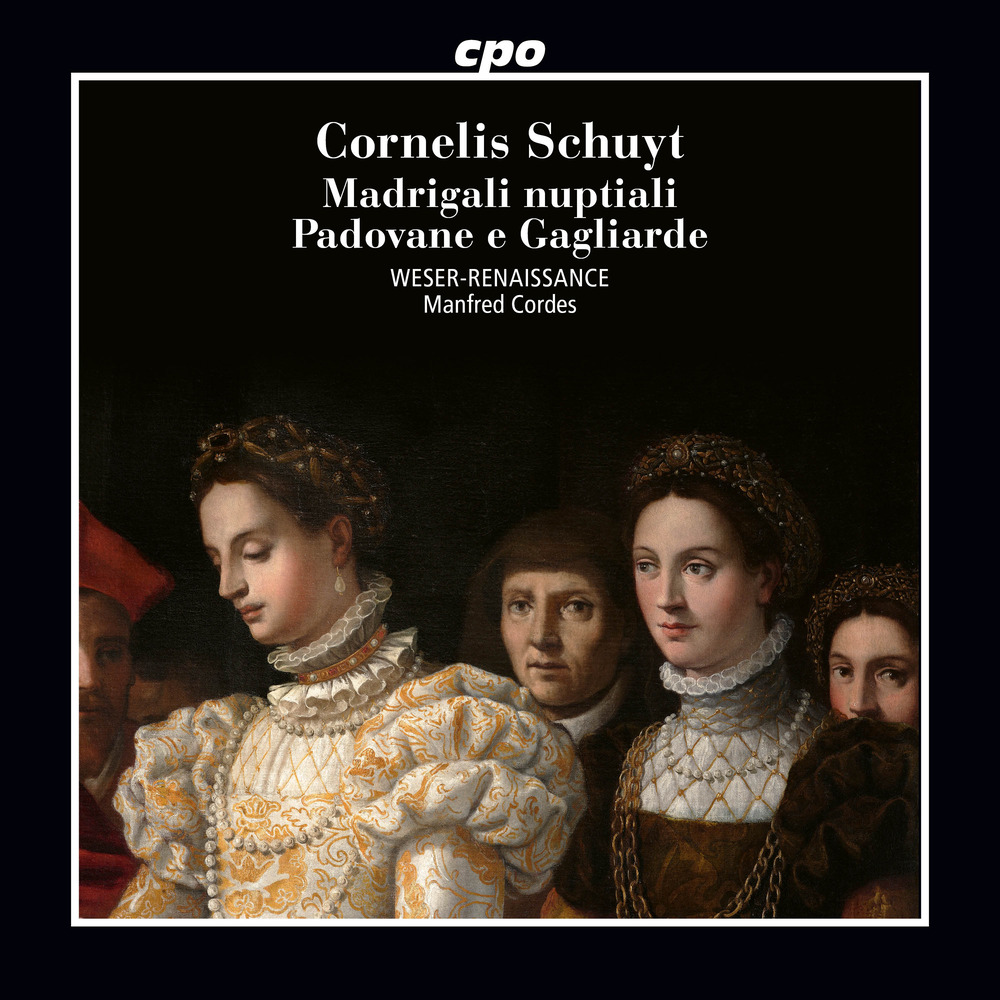
The album Cornelis Schuyt: Madrigali nuptiali · Padovane e Gagliarde by Weser-Renaissance, under the direction of Manfred Cordes, is a delightful journey into the refined and elegant music of the Dutch Renaissance. Schuyt's Madrigali nuptiali captures the joyful spirit of wedding festivities, while his Padovane e Gagliarde showcase his skill in dance forms. Weser-Renaissance's historically informed performance brings out the intricate polyphony and rhythmic vitality of these pieces, offering listeners a vibrant and authentic experience of Schuyt's artistry. This album is a treasure for early music enthusiasts and anyone captivated by the richness of Renaissance music.
Cornelis Schuyt had been profoundly influenced by his foreign travels in his younger years and retained an affection for the composition of madrigals. At the same time, the composition of secular repertoire could have represented an evasion on the decision between the different confessions which was at this time still an emotional topic. The selection of the Italian language, integral and intrinsic to the genre, set the character of his first book of madrigals dating from 1600 which included a preface by the author. A further additionally interesting collection led to independent compositions in the language of the country, similar to the predilection of English composers (originally Italian madrigals anglicised, i.e. in translation). This is a concept which could be related to the emancipation of the Dutch language, but was with great probability equally influenced by the association of Schuyt with the intellectual group Muyderkring within the circle of the poet and historian Pieter Corneliszoon Hooft at the magnificent Muyder Castle, situated ca. 15 km east of Amsterdam to which other individuals including Sweelinck and his friend Plemp also belonged. Hooft undertook responsibility for the residence and its property as the administrator of Moritz von Nassau, at this time the steward of seven provinces of the Republic.
It is astounding that Schuyt’s publications only began during the later part of his life. All the collections printed in Leyden date from the period 1600-1611. Three of these are devoted to secular vocal music and the final publication in 1611 was the volume featuring ensemble music with dances mentioned above. (This publication also contained a dedication to five men from the amateur music circle in Leyden, most probably members of a collegium musicum). The situation regarding the sources is poor: only a few copies are still in existence and none of these have survived in complete form! By this point in time, Schuyt’s father was already over 70 years old and it was almost certain that the son would inherit his position as organist, meaning that he could count on a rise in salary. The appropriate time had therefore arrived to have some of his music published.
In Il primo libro de madrigali a cinque voci dating from 1600, the above-mentioned preface is a mine of information and includes a dedication to the town of Leyden. What is more, a variety of individuals from the region are mentioned in the volume, for example an “illustrious cavalier” named Wassenaer, a Dutch aristocrat. The piece entitled Vieni, dolc’Hymeneo is clearly a multi-part wedding composition celebrating the connection forged between the prominent aristocratic houses of the Brederode and Oldenbarnevelt families, in particular the daughter of the then officiating public prosecutor who was put to death in 1619.
The pieces in this collection are highly varied, simple and popular in character, including dissonant passages whilst remaining harmonically within the familiar framework of the late sixteenth century. They clearly display a composer who is familiar with the style of writing for higher-ranking individuals in order to supplement his income. The compositions were not composed around the time of their publication. Some of the texts can be ascribed to Torquato Tasso; three of the pieces celebrate the town of Leyden!
The second collection Hollandsche Madrigalen was printed in 1603 and has only survived in incomplete form. It contains an enigmatic canon Bewaert Heer Hollandt, En zalicht Leiden. The scoring is on a larger scale than in the first volume, extending to a maximum of eight parts.
A further book of madrigals entitled Hymeneo overo madrigali nuptiali et altri amorosi, a sei voci con un echo doppio a dodeci, printed in 1611, continues the development of a feature from the first book. Hymen, o Hymenaie: the Greek god Hymen or Hymenaios, represented as a charming winged youth with a wedding flare in his hand, wears a yellow veil and is adorned with a wreath of flowers. He is a symbol for the wedding, the marriage ceremony.
These pieces are stylistically more highly developed and ornate with larger-scale scorings for up to twelve voices. The collection is again dedicated to a Duvenvoorde/Wassenaer (as was the case in one piece from the 1600 collection), but on this occasion to the renowned lieutenant-admiral of the United Provinces of the Netherlands, Jacob van Duvenvoorde, Heer van Obdam, Hensbroek, Spanbroek en Opmeer. It is clear from the contents that the dedicatee is an amateur music lover, singer and can accompany himself on the lute! The sequence of the pieces reveals an order dictated by the modal system. Once again, Italian has been selected as the language for the musical settings.
In the collection Nervi d’Orfeo printed in Leyden by Henrico Lodovico de‘ Haestens in 1605, Cornelis Schuyt finds himself with a madrigal in good company with illustrious names ranging from Marenzio, Croce, the Gabrielis and other Italians juxtaposed with Le Jeune, De Macque, P. Philips, Sweelinck, Verdonck, De Wert and Cornelis Schoonhoven (organist in Delft).
The well-known contemporary Christophe Plantin had been forced to flee from France, settling in Antwerp in 1549 where he became a citizen and set up a printing firm which would develop into one of the largest of its time. An immense volume of works was printed on up to 16 printing presses operated by the substantial workforce employed in his printing workshop. He was allotted a monopoly by Philip II to print all liturgical books for Spain, the Netherlands and the colonies and was simultaneously the official printer for the Protestant Netherlands State General – both tasks carried out by a single company! After having been denunciated, he was forced to flee from the Duke of Alba and after a number of detours arrived in Leyden where he established a subsidiary of his firm.
On his death in 1589, the printing business in the university town was inherited by his son-in-law Christoph Raphaelengius. There are only a handful of printed musical volumes published in his name in Leyden under the name Christoforo Rafelengio. These works included Sweelinck‘s Rimes francoises and Schuyt’s Primo libro, Hymeneo and thee Hollandsche Madrigalen which although originating from the “Plantijnsche Druckerije”, were published “op kosten van Jan Jansz. Orlers“. (The latter was not only the author of the Beschrijveninge der Stadt Leyden published in 1641, but is also considered the first biographer of Rembrandt). Generally, it was chiefly books which were printed in Leyden alongside a relatively small number of musical editions. The printers seldom actually owned their own equipment for musical typesetting, instead having to hire it in certain cases! The situation was quite different in Antwerp where the highly active Pierre Phalèse had specialised himself in reprints of Italian collections.
The extravagance of the Dutch occasionally threatened to get somewhat out of hand and clothing was not always limited to the decorous regulations! The extensive fashion fad in the (alleged) style of the Japanese led not only to certain individuals wearing a kimono for their wedding, but ultimately provoked a prohibition on the part of the Leyden senate in 1725: the wearing of the ‘Japon’ as the kimono was also termed, had even been adopted by students as everyday wear. In order to rein in this outbreak of waywardness, the wearing of this article of clothing was prohibited in church!
Veronika Greuel
Translation: Lindsay Chalmers-Gerbracht
|
1.1
|
Fortuna Guida: Canzon
|
2:03 |
|
1.2
|
Al giogo d‘Hymeneo
|
3:16 |
|
1.3
|
Se non saetta Amore
|
1:54 |
|
1.4
|
Del primo modo: Padovana 1 · Gagliarda 1
|
4:28 |
|
1.5
|
Gentil signor
|
4:07 |
|
1.6
|
Amor, ch‘in dolce nodo
|
5:26 |
|
1.7
|
Del quinto modo: Padovana 5 · Gagliarda 5
|
4:35 |
|
1.8
|
Io piango
|
3:32 |
|
1.9
|
Gentil, vaga brunetta
|
3:07 |
|
1.10
|
Del sesto modo: Padovana 6 · Gagliarda 6
|
4:12 |
|
1.11
|
Là ver l‘aurora
|
2:48 |
|
1.12
|
Vivi, festeggia e godi
|
2:36 |
|
1.13
|
Del nono modo: Padovana 9 · Gagliarda 9
|
4:30 |
|
1.14
|
Ahi che l‘età sen vola
|
2:49 |
|
1.15
|
Giovene nato
|
2:26 |
|
1.16
|
Del undecimo modo: Padovana 11 · Gagliarda 11
|
3:33 |
|
1.17
|
Altro non è il mio amore
|
2:49 |
|
1.18
|
Poi ch‘ho perso quel bene
|
5:33 |
|
1.19
|
La Barca: Canzon
|
2:15 |
Cornelis Schuyt; Weser-Renaissance; Manfred Cordes