Program: #26-29🏆 Air Date: Jul 13, 2026
The Camerata Antonio Soler gives us a program of later Baroque and Galant composers in the New World, including not only more familiar names like Ignacio Jerusalem and Esteban Salas, but also rarely-heard instrumental works.
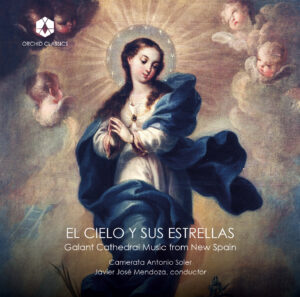
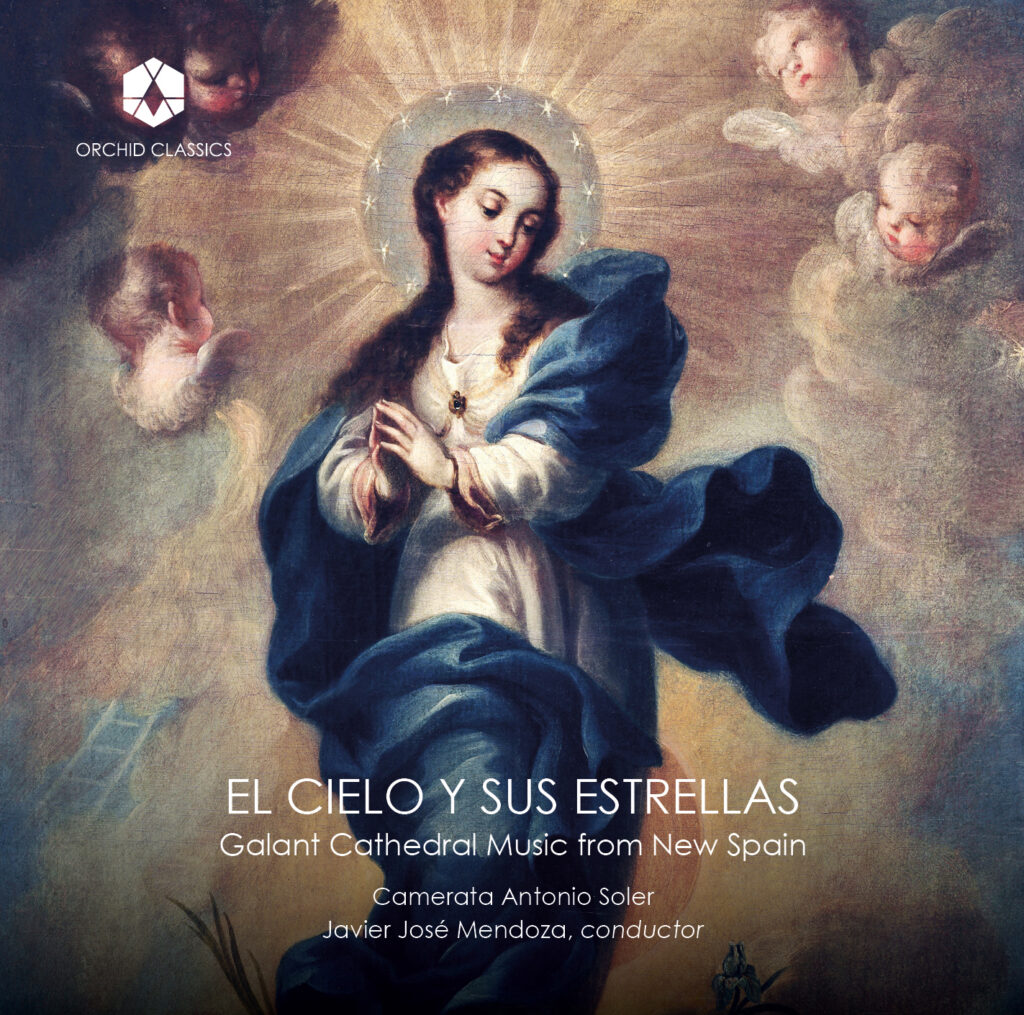
NOTE: All of the music on this program is from the recording El Cielo y Sus Estrellas (Camerata Antonio Soler/Javier José Mendoza). Orchid Classics ORC 100208.
People in the eighteenth century, especially the wealthy and well connected, witnessed a cosmopolitan world that interconnected in ways that had never been experienced before. Germans drank coffee grown in Africa, Mexicans cherished art produced in the Philippines, and natural resources from the Americas flowed into Europe. The horrendous reality of the transatlantic slave trade facilitated the economic model of this new age, but advances in science, technology, philosophy and other areas also shaped it. Music formed an inextricable aspect of eighteenth-century culture, and it was Italian music that people prized the most for its modernity, expression, and grace. Demand surged not only for Italian music, but also for Italian musicians, whose high level of training became the currency for the fashionable galant style which by the mid-century was known throughout Europe and its overseas empires.
An outstanding example of the cosmopolitanism of his age, the southern Italian composer Ignacio Jerusalem (1707-1769) learned music in his native Lecce, studied cello and composition in Naples, became embedded as a musician with a Spanish military regiment in North Africa, and finally embarked for Mexico City, the largest city in the New World. It was there that he would work as chapel master of the city’s metropolitan cathedral. One of the first non-priests to serve in that capacity at the cathedral, Jerusalem unapologetically wrote modern galant music for this very un-European place, updating the musical forms traditionally used at the cathedral, but also allowing those traditions to shape his own music in new ways. Jerusalem wrote over 250 works for Mexico City Cathedral, and some of those works would be distributed more widely in North America than any other composer of the colonial period.
The three works by Jerusalem featured on this recording explore the joys and the sorrows of the Virgin Mary. Si aleve fortuna presents her as the Mother of God whose Son gave his life for humanity, whereas Qué dolor, qué desconsuelo features an obligado flute that more directly expresses Mary’s sorrows: “Where,” she asks “will I find him who will relieve my pain?”. Sube a gozar recounts the ecstasy of Mary’s Assumption into Heaven. Jerusalem wrote these pieces in the 1750s when music with Spanish language texts was still sung in Mexico City Cathedral. Thereafter, copies of these works made their way to Durango Cathedral and elsewhere, where they continued to be used for some decades.
Jerusalem may be the only composer known to have worked on three continents in the eighteenth century, but he is by no means the only cosmopolitan figure presented on this recording. Santiago Billoni (c.1700-1763), a violinist and composer born in Rome, also travelled to New Spain, where he played in the chapels of several cathedrals before becoming chapel master at Durango Cathedral. He and Jerusalem were the only Italians to work as chapel masters in what is now Mexico. Billoni’s music is darker than Jerusalem’s and tends to showcase the violin; in fact, he wrote the parts for himself to play. Por qué Pedro is a dialogue between Christ and St. Peter that dramatizes Peter’s denial of Christ and Christ’s forgiveness.
One of the new music genres par excellence that first appeared in the eighteenth century was the symphony. In its early stages, the symphony resembled an opera overture, and tended to have three short movements. The three short symphonies here were probably written in Iberia, but their scores found their way to churches in Mexico where they are preserved today. The Symphony in B flat is the work of Luis Misón (1727-1776), the son of a French oboist born in Catalonia who would become one of Madrid’s most important composers of zarzuela during the century. The Valencian composer José Herrando (c.1720-1763) wrote some of the most significant music for violin in eighteenth-century Spain, and his Symphony in D Major captures the spirit of the symphonies of Sammartini, one of the genre’s founders. Finally, La tempestad del mar, a topical symphony by the Neapolitan composer Davide Perez (1711-1778), depicts a storm at sea and its aftermath, a rainbow. In an age of sea travel, such storms were frequently depicted in music, and the rainbow offers hope to the faithful. A composer well-known in much of Europe in his own day, Perez spent much of his career in Lisbon, where he likely wrote this symphony. Although these composers remained in Europe, their music crossed the Atlantic where it was likely performed for decades.
© Drew Edward Davies, Northwestern University
David Pérez (1711-1778)
Sinfonía en Re “La tempestad del mar”
1. I Allegro
2. II Arco iris
3. III Bailete
Ignacio Jerusalem (1707-1769)
4. Si aleve fortuna
Molly Netter, soprano
Luis Misón (1720-1766)
Sinfonía en Sib
5. I Allegro
6. II Andante
7. III Presto
Santiago Billoni (c.1700-1763)
8. ¿Por qué Pedro?
Molly Netter, soprano
David Trillo, tenor
Ignacio Jerusalem
9. Qué dolor, qué desconsuelo
José Hernández Pastor, countertenor
Laura Quesada, flute
José Herrando (1680-1763)
Sinfonía en Re
10. I Allegro
11. II Andante
12. III Allegro
Ignacio Jerusalem
13. Sube a gozar
Eleanor Ranney-Mendoza and Molly Netter, sopranos
Esteban Salas y Castro (1725-1803)
14. El cielo y sus estrellas
Molly Netter and Eleanor Ranney-Mendoza, sopranos
José Hernández Pastor, countertenor