Sacred Early Baroque German Music

Program: #20-21💎   Air Date: May 11, 2020

To listen to this show, you must first LOG IN.

Motets from Saxony in 1603, music from the Thirty Years War, and Le Petite Bande performing Heinrich Schutz.

Previous:#20-20 🔒💎Ockeghem: Masses 2
Next:#20-22 🔒💎Women of Spirit

I. Florilegium Portense: Motets & Hymns (Vocal Concert Dresden/Cappella Sagittariana Dresden/Peter Kopp). Carus CD 83.492.
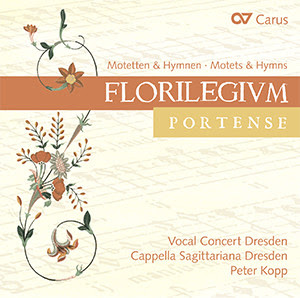
20-21a_Florilegium_Portense.jpg

Florilegium Portense – this is the title of a collection of sacred motets from Italy, Germany and the Franco-Flemish region, first printed in Leipzig in 1618. It contains motets by the most famous composers of the time in Europe, such as Hieronymus and Michael Praetorius, Hans Leo Hassler, Orlando di Lasso, and Andrea and Giovanni Gabrieli. Its dissemination was so successful that almost all church choirs, school choirs and court orchestras between Eisenach and Breslau came into contact with it.

The motets were compiled by Sethus Calvisius, the cantor of Schulpforte and later Thomaskantor of Leipzig, and edited by Erhard Bodenschatz, his successor in Schulpforte. Exactly 400 years after going to press, the Vocal Concert Dresden and the Cappella Sagittariana under the direction of Peter Kopp honour this important cultural monument with a recording of selected motets and hymns, including several premiere recordings.

  • Benedicam Dominum in omni tempore / Hieronymus Praetorius (1560–1629)
  • Si bona suscepimus de manu Domini / Hans Leo Hassler (1564–1612)
  • Sit nomen Domini benedictum / Arcangelo Borsaro (c. 1560–1617)
  • Confitebor tibi Domine / Orlando di Lasso (1532–1594)
  • Hymnus "Jam lucis orto sidere" / Sethus Calvisius (1556–1615)
  • Cor mundum crea in me Deus / Andreas Pevernage (1542/43–1591)
  • Herr, wenn ich nur dich hab / Melchior Franck (c.1579–1639)
  • Ecco quomodo moritur justus / Jacobus Gallus (1550–1591)
  • Hymnus "Deus sator mortalium" / Sethus Calvisius
  • Praeter rerum seriem ("Parode ad Josquini") / Sethus Calvisius
  • Das alte Jahr vergangen ist / Michael Praetorius (1571–1621)
  • Tristis est anima mea / Agostino Agazarri (1578–1640)
  • Christus resurgens ex mortuis / Giovanni Battista Stefanini (1574–1630)
  • Jubilate Deo omnis terra / Giovanni Gabrieli (1557–1612)
  • Quam pulchra es amica mea / Erhard Bodenschatz (1576–1636)
  • Hymnus "Te lucis ante terminum" / Sethus Calvisius
  • Ecce quam bonum et quam jucundum / Adam Gumpelzhaimer (1559–1625)

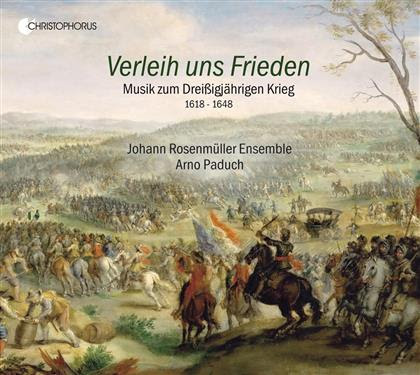
II. Grant us Peace—Music for the Thirty Years’ War (Johann Rosenmuller Ensemble/Arno Paduch). Christophorus CD CHR 77424.

20-21b_Verleih_uns_Frieden.jpg

From Music Dei Dominum: The Thirty Years War (1618-1648) had a very damaging effect on the state of the arts in Germany. The most famous German composer of the 17th century, Heinrich Schütz, described its effect this way: "Among the other free arts the noble art of music has not only suffered great decline in our beloved fatherland as a result of the ever-present dangers of war; in many places it has been wholly destroyed, lying amid the ruins and chaos for all to behold". The war had taken away most of the financial resources which otherwise would have been spent to art, and musicians had died as a direct or indirect effect of the war.

In 1998 Weser-Renaissance recorded a programme to mark the Peace of Westphalia of 1648, which brought the war to an end (CPO, 1999). This year (2018) the outbreak of the war is commemorated. As far as I know this fact has been given little attention by ensembles; the present disc is the only one which has been specifically been recorded to mark this event. The origins of the Thirty Years War and the way it developed is outlined in the liner-notes by Arno Paduch. It shows that it was a quite complicated affair, in which religion, politics and personal ambitions all played their roles. At first the effects of the war were limited, but things turned for the worse, when Sweden intervened and as a result other major European powers got involved.

Obviously the war is reflected in the music written at the time. In some cases a piece is directly connected to a particular event. For instance, Machet die Tore weit, a setting of verses from Martin Luther's translation of Psalm 24, was written by Nicolaus Weisbeck at the occasion of the arrival of Johann Georg I, Electoral Prince of Dresden, at a convention in Mühlhausen in March 1620, in an attempt to create a Lutheran/Catholic alliance. At the time Weisbeck was Kantor of the Marienkirche at Mühlhausen. His oeuvre is rather small, and apparently he stuck to the stile antico; this motet is for six voices, and in the performance on this disc the singers are accompanied by the organ. The convention resulted in military actions, among them the battle of the White Mountain in November 1620. At this occasion Johann Sixt von Lerchenfels composed the two pieces included here. Te Deum laudamus and Da pacem Domine are both in the stile antico and scored for four voices; again the singers are supported by the organ. They were printed in 1626 and dedicated to Emperor Ferdinand II.

A crucial part in the emergence of the war was the revolt of Protestant Bohemians against Ferdinand. In June 1621 a number of Protestant noblemen were hanged in Prague. One of them was Christoph Harant von Polschitz und Weseritz, who was also a poet and a composer. To mark this event Paduch included a composition from his pen, the 6-part motet Qui confidunt in Domino, which he composed during a pilgrimage to the Holy Land in 1598. Paul Schäffer, instrumentalist in the service of the city of Breslau, composed Venite exultemus in honour of the Elector Johann Georg, who on 3 November that year, as the emperor's representative, accepted the homage of the Silesian Diet at Breslau. It is assumed that Heinrich Schütz's Syncharma musicum was performed at the same occasion, but that is impossible to prove. His Teutoniam dudum belli is also associated with this event, but Paduch suggests it may have been written at the occasion of one of the peace agreements in the subsequent decades.

Schütz and Weckmann are the only well-known composers included in the programme. Most of the others are hardly known, or not at all. The latter goes, for instance, for Marcus Dietrich Brandisius, who is not included in New Grove. He was a student in Leipzig and pupil of the Thomaskantor Johann Hermann Schein. In Fortes heroes pugnabant he depicts the battle at Breitenfeld near Leipzig. In a way it is reminiscent of Claude Janequin's chanson La guerre: the six stanzas end with the same line: "Trarararara / Bombombom, bidibidibom". Very different in character is the solo song Ach Gott! Wir haben's nicht gewusst, was Krieg für eine Plage ist by Johann Hildebrand, an organist and poet. The piece is from a collection of laments, seemingly inspired by the atrocities of the war. "O God! We did not know what plague is a war! Now we are experiencing all too closely that war is the mother of all plagues". Hildebrand is clearly influenced by Schütz in this setting for solo voice and basso continuo (here played at the chitarrone).

Weckmann's sacred concerto Wie liegt die Stadt so wüste was written after the war, but "the sight of the devastated , depopulated regions he travelled through on his journeys between Dresden and Hamburg must have had a decisive influence on the origin of this composition", Paduch writes. However, it is generally assumed that this piece was written at the occasion of the plague in Hamburg in 1663. As it has been recorded quite a number of times before I would have liked to hear different music instead. However, considering the number of pieces by little-known composers we probably should not complain.

It was certainly a good idea to end the programme with two motets from Schütz's collection Geistliche Chor-Music. It was published in 1648, the year of the Peace of Westphalia, and the two motets sum up what many Germans may have thought as they suffered the effects of the war: "Grant us peace graciously, Lord God, in our time; there is indeed no othr who could fight for us than you, our God, alone" - "Give our rulers and all lawgivers peace and good government, that under them we might lead a quiet and peaceful life in all blessedness and honour. Amen." Schütz knew from own experience all too well what damage a war could do.

It is a bit disappointing that so little attention has been paid to the start of the Thirty Years War. From that perspective we have to welcome this disc. The inclusion of so many unknown pieces speaks also in its favour, although not every piece is of the highest quality. That said, I feel that the performances don't always do them full justice. One factor is the acoustic: the programme has been recorded in a church, but either its acoustic is very dry or the recording technique has played its part here. I would have liked a bit more space around the musicians. That probably would have had a positive influence on the ensemble, because the blending of the voices is not the best. This is not a fixed ensemble, and that could be partly responsible for a lack of ensemble. The direct recording plays its part here too. I am not questioning the quality of the singers or the players: these are all experienced in this kind of repertoire, and with the likes of Veronika Winter, Georg Poplutz (excellent in Hildebrand's song) and Dominik Wörner we have really top-class singers. But for various reasons the programme doesn't come really off the ground.

This is certainly a very interesting recording, but musically it leaves me a bit unsatisfied.

Johan van Veen

  • Marcus Dietrich BRANDISIUS (17th C): Victoria Sveco-Saxonica (Fortes heroes pugnabant);
  • Andreas DÜBEN (c1597-1662): Pugna triumphanis (Bonum certamen certavi);
  • Christoph HARANT VON POLSCHITZ UND WESERITZ (1564-1621): Qui confidunt in Domino;
  • Johann HILDEBRAND (1614-1684): Ach Gott! Wir haben's nicht gewußt, was Krieg für eine Plage ist;
  • Paul SCHÄFFER (c1580-c1645): Venite exultemus (Actus gratulatoris);
  • Heinrich SCHÜTZ (1585-1672): Da pacem Domine (SWV 465); Syncharma musicum (En novus elysiis) (SWV 49); Teutoniam dudum belli (SWV 338); Verleih uns Frieden - Gib unsern Fürsten (SWV 372/373);
  • Johann SIXT VON LERCHENFELS (c1555-1629): Da pacem Domine; Te Deum laudamus;
  • Matthias WECKMANN (c1619-1674): Wie liegt die Stadt so wüste;
  • Nicolaus WEISBECK (c1575-c1640): Machet die Tore weit (Votiva Oeolica acclamatio); 

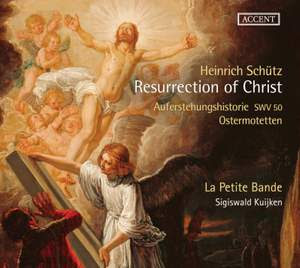
III. Heinrich Schütz: Resurrection of Christ (La Petite Bande/Sigiswald Kuijken). Accent CD ACC24355.

20-21c_Heinrich_Schutz__Resurrection_of_Christ

The ‘History of the Joyous and Victorious Resurrection of Our Only Saviour and Redeemer Jesus Christ’, composed by Heinrich Schütz in 1623, is regarded as the first oratorio in the German language.

When Schütz had taken up his functions at the Dresden court in 1617, it was the tradition to sing the Resurrection History of his predecessor Scandello at Easter. The new Kapellmeister gave several performances of this work before deciding to compose a new work on the same text.

The Thirty Years War had broken out in 1618, plunging Germany into a long period of tragedy. It was in this context that Schütz was to compose his most luminous works, those most imbued with faith and those which most clearly echo the experience he had acquired in Italy, which had already been completely conquered by the modern style.

The Resurrection History, like no other work of Schütz, is packed with feats of harmonic derringdo - frequent use of augmented chords and surprising chord progressions juxtaposing distant keys after the manner of the stile concitato invented by Monteverdi, to mention only the most striking.

From Ionarts: Heinrich Schütz (1585-1672) incorporated the musical style of Giovanni Gabrieli, with whom he studied in Venice, into the Lutheran church music he wrote in Dresden. Sigiswald Kuijken and La Petite Bande have released this charming selection of the composer's Easter-themed music cleverly in coordination with that feast this year. The pieces, four shorter motets and a longer Easter Oratorio, show the ingenious ways that Schütz turned the concerto style to his advantage. In Weib, was weinest du?, the Easter dialogue between Mary Magdalen and the risen Christ, the four voices provide a multiphonic dialogue of the two interlocutors, layered on top of one another. At the moment of recognition ("Maria! -- Rabboni!"), Schütz uses unexpected harmonic progressions to underscore Mary's surprise. For some reason Kuijken omits the Christ ist erstanden von dem Tod, Martin Luther's Easter hymn, which Schütz appended to the motet.

Schütz uses Gabrieli's cori spezzati texture, two SATB choruses played off one another, in Singet dem Herrn and in the shorter Ich bin die Auferstehung, with its emphasis on the word "nimmermehr" (whoever believes in me shall never die) through contrapuntal iteration. In Ich weiß, daß mein Erlöser lebt, dance rhythms percolate through the seven-voice texture. The longer Easter Oratorio provided Bach with part of the blueprint for his longer Passions, with the tenor Evangelist's narration accompanied by three violas da gamba, for example. This piece is drier in style than the more focused motets, with long stretches of recitative for the Evangelist and little snippets for the other characters, often portrayed by two or three voices together. Kuijken and his organist, Mario Sarecchia, provide most of the continuo realization with simplicity. A tight ensemble of singers handles the vocal pieces, one to a part, with only some overly nasal tone in the tenors to spark minor complaint. —Charles Downey

  • Motets. Weib, was weinest du?, SWV 443 (4:04)
  • Ich bin die Auferstehung und das Leben, SWV 464 (2:37)
  • Ich weiss dass mein Erlöser lebt (2:46) 
  • Singet dem Herren ein neues Lied, SWV 35 (4:35)
  • Historia der Auferstehung Jesu Christi, SWV 50 (42:55).
Previous:#20-20 🔒💎Ockeghem: Masses 2
Next:#20-22 🔒💎Women of Spirit

Composer Info

Hieronymus Praetorius (1560–1629), Hans Leo Hassler (1564–1612), Arcangelo Borsaro (c. 1560–1617), Orlando di Lasso (1532–1594), Sethus Calvisius (1556–1615), Andreas Pevernage (1542/43–1591), Melchior Franck (c.1579–1639), Jacobus Gallus (1550–1591), Michael Praetorius (1571–1621), Agostino Agazarri (1578–1640), Giovanni Battista Stefanini (1574–1630), Giovanni Gabrieli (1557–1612), Erhard Bodenschatz (1576–1636), Adam Gumpelzhaimer (1559–1625), Marcus Dietrich BRANDISIUS (17th C), Andreas DÜBEN (c1597-1662), Christoph HARANT VON POLSCHITZ UND WESERITZ (1564-1621),Johann HILDEBRAND (1614-1684), Paul SCHÄFFER (c1580-c1645), Heinrich SCHÜTZ (1585-1672), Johann SIXT VON LERCHENFELS (c1555-1629), Matthias WECKMANN (c1619-1674), Nicolaus WEISBECK (c1575-c1640)

CD Info

Carus CD 83.492, Christophorus CD CHR 77424, Accent CD ACC24355.